Zest
Zest Back
en
  • Platform
      Continuous Listening

      Detect, understand, act. Before it's too late.

      HR Survey, Employee Engagement BarometerPulse SurveyExpertise & Science
      LAB
      Expertise & Science
      Performance & Reviews

      Structure, manage, develop. For greater performance.

      Annual & Pro reviewsObjectives & OKR180° & 360° FeedbackPeople Review
      Zest AI

      Analyze. Prioritize. Act. Go from insights to action plans in 1 click.

      IA & AnalyticsSemantic AnalysisAction plan
  • Use cases
      Your use cases
      Employee engagementEmployer brandHR PerformancePeople AnalyticsQWLCFeedback Culture
      Your Industry
      Bank & InsuranceIndustryRetailHealthPublic sectorServices

      "I would recommend Zest for the support they provide during rollout and with day-to-day use."

      Mélanie Guivarch
      HR Manager at Les Petites Canailles
      Exchange with a Zest expert
      From HR feedback to business impact
      Request a demo
  • Success stories
      Our use cases
      CourirCelioU EnseigneL'assurance RetraiteGaranceMore Success Stories
      Discover
  • Pricing
  • Ressources
      Blog
      BlogWhite papersWebinars
      Press
      External ublicationsPress Releases
      BaromEX 2026
      Pre-register
Log in Book a demoDemo
Log in
Book a demoDemo
en

The eNPS (Employee Net Promoter Score) for measuring employee engagement?

Au programme :
Viviane Rodriguez
Feb. 18, 2021

Le récap de l’article

Used by organizations such as Apple, Rackspace or Verizon, eNPS or NPS Employee is presented as the reference tool for measuring employee engagement. But, is it enough for a complete assessment of the state of your teams?

Used by organizations such as Apple, Rackspace or Verizon, eNPS or NPS Employee is presented as the reference tool for measuring employee engagement. But, is it enough for a complete assessment of the state of your teams?

The concept is inspired by the NPS or Net Promoter Score, a barometer created in 2003 by the consulting firm Bain & Co, created to measure customer satisfaction and consisting of a single question: ” Would you recommend our products/services to other people?” The eNPS is the equivalent, but it is used to measure employee engagement. In the same way, they are asked a single question:
How likely is it that you would recommend our organization to a friend or colleague ?
The answer is given on a scale from 0 (not at all likely) to 10 (very likely). This question prompts respondents to rate the various aspects of their experience with the organization, and the rating they give reflects their overall level of commitment. Recently, the eNPS methodology has been expanded to measure other aspects related to employee’s engagement, such as their loyalty, their trust in their company’s products or services and their overall satisfaction, through three additional questions:  

Loyalty

If you were offered the same job you have, but in another company, how likely is it that you would stay in your current company ?

Belief

How likely is it that you would recommend your company’s products or services to your friends and family ?

Satisfaction

Overall, how satisfied are you working at your current company? Companies can decide whether or not to use these three questions in addition to the main question to complement the eNPS results. If they decide to use them, they will also need to take these answers into consideration when calculating their engagement score.  

What is the purpose of the eNPS or NPS employee?

Several studies prove it, commitment boosts teams’ performance. Committed employees become more involved in the life of the organization, which generates better results and reduces turnover rates. These figures speak for themselves:
  • 3 out of 4 employees have little or no commitment (worldwide)
  • The cost of the disengagement is €12,600 per year and per employee.
  • 19% of employees resign when they do not feel listened to by their managers
  • 27% is the engagement rate of employees when their managers do not deal with issues that are important to them.
  • But this rate increases to 63% when managers take action based on the results of employee surveys.
Measuring your employees’ level of engagement is, therefore; very important, and eNPS can give you some insight.

How to calculate the eNPS :

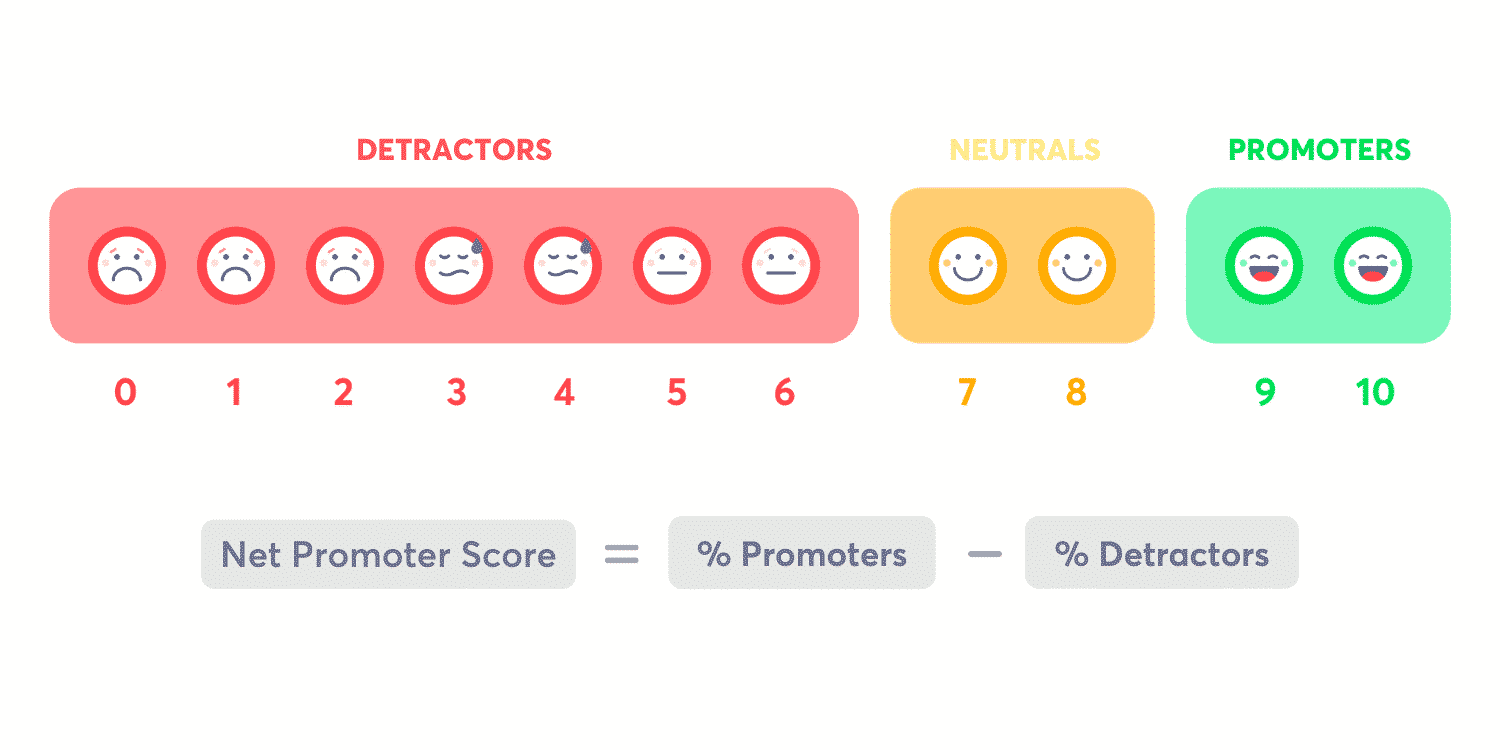
The first step in calculating your employee engagement score is to divide the answers to the eNPS questions into three categories:
  • Promoters: score 9-10
The employees gave the best scores. They are considered highly committed and are ambassadors for your organization.
  • Passives: score 7-8
Even if these employees don’t really have a negative view of their experience within the company, they’re not really engaged either.
  • Detractors: score 0-6
They are the ones who gave the lowest scores to the eNPS questions. These employees are clearly disengaged. The formula to be used afterwards to calculate your score is the following :
  • eNPS = % Promoters – % Detractors
For example, if a company has : 70% promoters, 5% passives and 25% detractors, its eNPS score is : 70 – 25 = 45 The NPS® scale ranges from 100 (a perfect score with 100% promoters) to – 100 (worst case scenario with 100% detractors). Any score above 0 is considered satisfactory because it means that your company has more promoters than detractors. Any score above 25 is considered very satisfactory and any score above 50 is exceptional.

The eNPS alone is not enough…

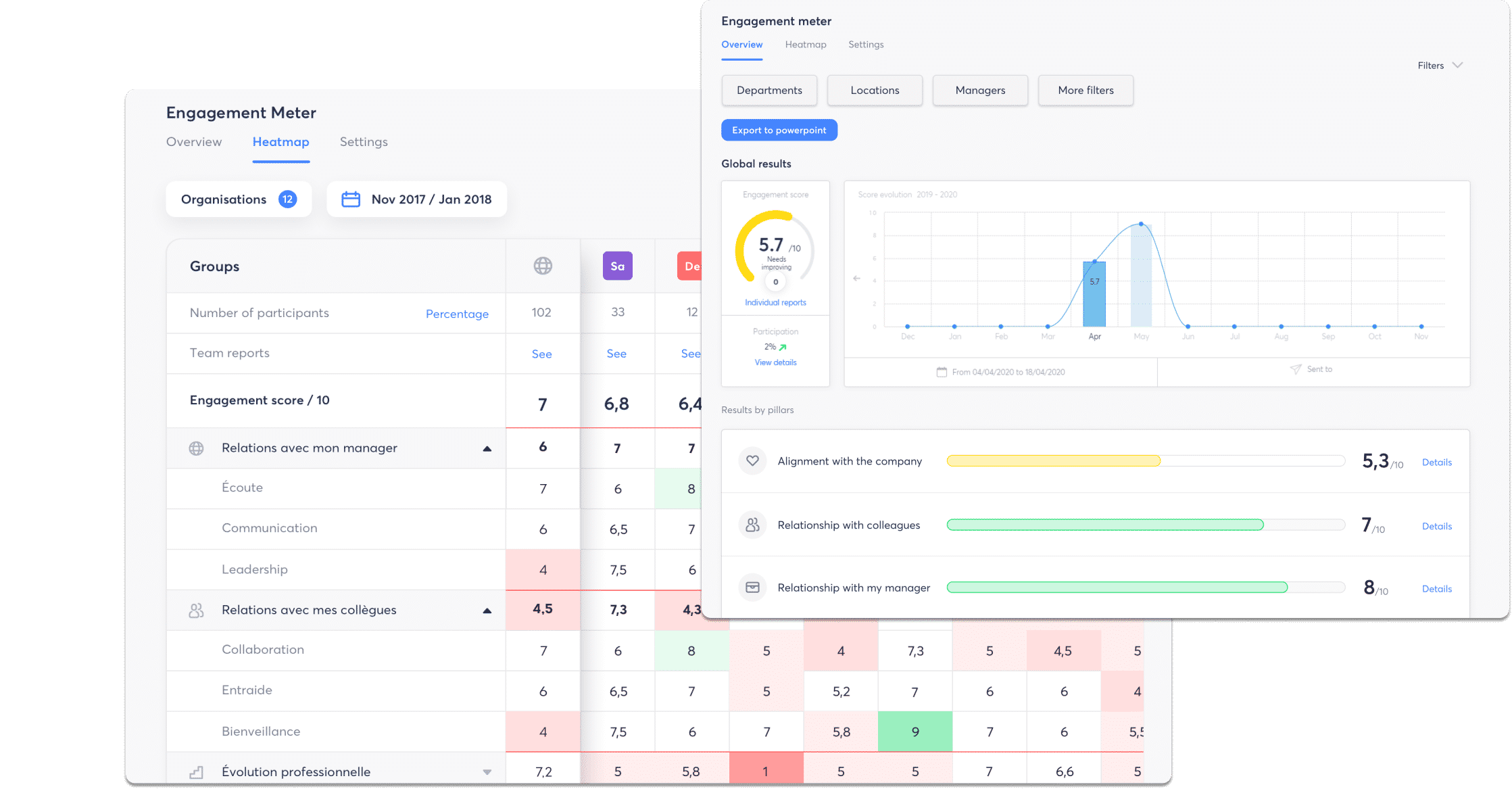
The eNPS only presents an overview of the current situation in the organization and does not really allow you to identify areas for improvement. It is therefore important to go beyond it by providing a more complete assessment of your employees’ engagement. Zest’s Engagement Meter divides engagement factors into six simple categories that your employees rate and comment on. It therefore makes it possible to identify the most important areas for your employees thanks to 18 Key drivers defined by a PhD in psychometrics. Polls can also be used at an organization-wide level, or at each department, to invite employees to give their opinion on one or more topics.

💡 Find out more about Zest’s engagement meter and “Listen” pillar.
Our expert’s advice : 

It is essential to go beyond the simple measurement of employee engagement and transform it into concrete actions. To do this, you need to identify the values that motivate your employees and activate these drivers. .
Share
  • Ressources
    • Tool : Estimate your ROI
    • Tool : Questionnaire generator
    • Barometer 2026 
  • HR software
    • Engagement Software
    • Feedback 360° Software
    • Performance review Software
    • People Review Software
    • Objective, OKR Software
    • Action plan
  • Zest
    • Why Zest
    • About Us
    • Partners
    • Careers
    • GDPR/Data Security
Sign up
hello@zestmeup.com
+33 9 72 62 45 00
Copyright © 2026 Zest
Terms of Use
Imprint
GDPR/Data Security
Allow all cookies
Continue without accepting
Zest Logo
Zest respects your privacy
Zest and its partners use cookies or similar technologies and process personal data which may be cross-referenced with information provided as part of our services for the following purposes: to improve your user experience, to carry out audience statistics and studies to improve our offers, to provide you with services tailored to your interests, to display targeted advertising on our site or those of our partners, and to measure the performance of such advertising. Some cookies are necessary for the operation of the site and our services. You can accept, manage your preferences by purpose or continue browsing without accepting.
Cookie settings
Allow all cookies
Google Tag Manager
Read more - View official website
✗ Reject
✓ Allow
Hubspot
Read more - View official website
✗ Reject
✓ Allow
Facebook
Read more - View official website
✗ Reject
✓ Allow
⚙ Save
✗ Continue without accepting
✓ Allow all cookies
PRIVACY POLICY