OKR Software: Deploy the OKR Method with Ease
Driving collective performance and aligning your teams around shared objectives has never been simpler. The OKR (Objectives and Key Results) methodology has established itself as the strategic management framework of choice. But how do you effectively deploy this methodology throughout your organization?
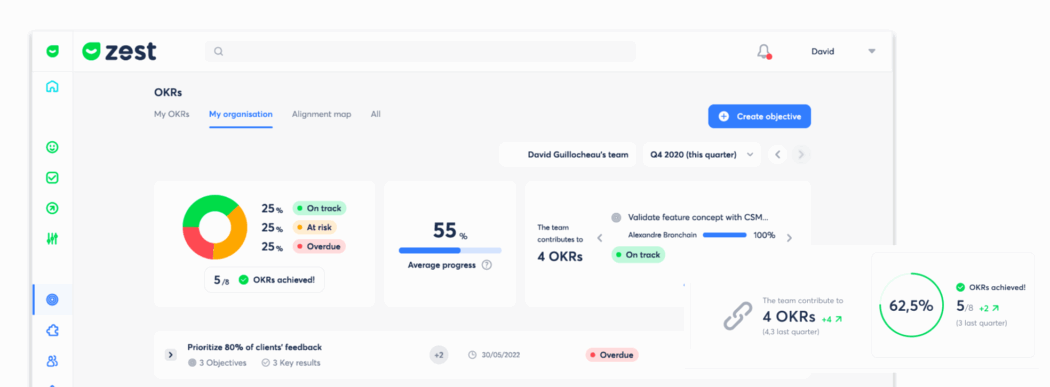












Dedicated OKR software quickly becomes essential for structuring, tracking, and optimizing your company objectives when implementing the OKR approach. Zest supports you through this transformation by offering an intuitive solution that centralizes the definition, tracking, and analysis of your individual and collective OKRs. Discover how our platform simplifies OKR implementation.
How Does the OKR Method Work?
The OKR method is built on a simple yet powerful principle: define Objectives (qualitative and inspiring goals) linked to Key Results (quantifiable outcomes) to concretely measure their achievement.
- Objectives represent the direction to pursue, the ambition you want to realize. They should be motivating, memorable, and aligned with the company’s strategic vision. For example: “Become the customer satisfaction leader in our industry.”
- Key Results are the measurable indicators that prove the objective has been achieved. For each Objective, you typically define 2 to 5 quantified and time-bound Key Results. Examples: “Achieve an NPS of 70” or “Reduce churn rate to below 5%.”
Why Manage Your OKRs with Dedicated Software?
Managing OKRs through Excel or email quickly reveals its limitations: loss of visibility, tracking difficulties, lack of team engagement. Specialized OKR software radically transforms your approach to performance management.
 Data Centralization

All your objectives—whether individual, team, or company-wide—are consolidated in a single platform accessible to everyone. Gone are scattered files and conflicting versions: everyone accesses the organization’s OKR progress in real-time.
 Real-Time Tracking

Quickly identify gaps between ambitions and results. Rather than waiting until quarter-end to discover a shortfall, managers can adjust trajectory within the first few weeks and reallocate resources as needed.
 Strategic Alignment

OKR software maps the connections between company objectives and individual contributions, reinforcing each employee’s sense of purpose and engagement. Everyone understands how their daily work feeds into the broader vision.
 Transparency and Collaboration

When everyone’s OKRs are visible to all, teams spontaneously support one another, share best practices, and collectively celebrate successes. This culture of transparency, characteristic of high-performing organizations, cannot emerge without the right tool.
Administrative Time Savings

Automated reminders, pre-configured dashboards, and auto-generated reports free managers and employees from time-consuming tasks, allowing them to focus on what matters: achieving objectives.
How to Set and Measure OKRs with ZestMeUp Software?
Zest simplifies every stage of the OKR cycle, from initial definition to results measurement, including continuous progress tracking.
Set Customized OKRs for Each Employee
Defining relevant individual OKRs begins with quality management dialogue. Zest facilitates this process through predefined templates that serve as starting points for reflection.
Each individual Key Result is linked to precise metrics: baseline value, target to achieve, update frequency. Employees become autonomous in tracking their progress and can request help as soon as a blocker emerges.
Set Customized OKRs for the Company
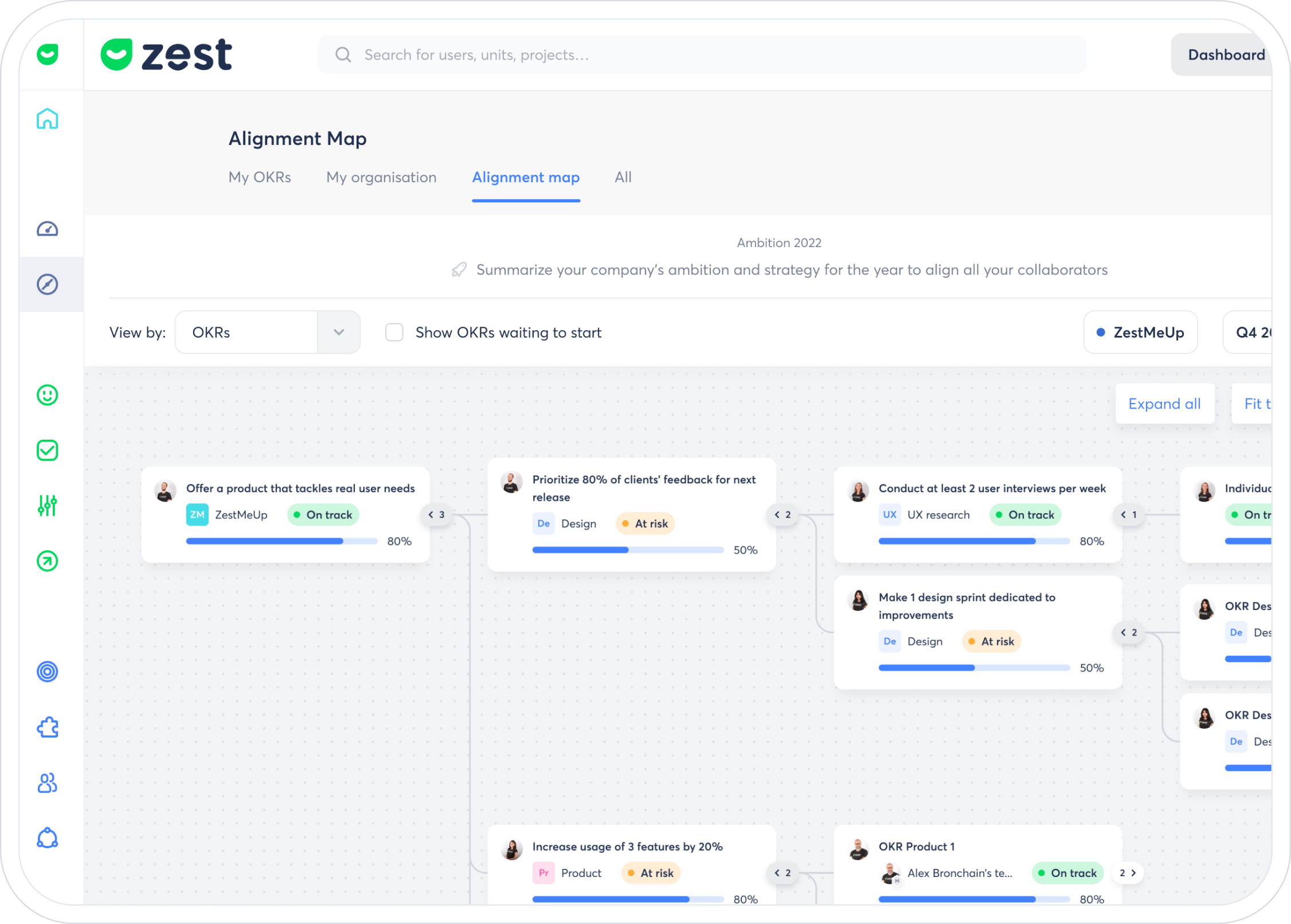
Company OKRs define the strategic trajectory for the upcoming quarter.
The platform encourages limiting the number of company OKRs (typically 3 to 5 objectives maximum) to maintain focus. Each Objective is enriched with contextual description that clarifies strategic stakes and inspires teams.
Once company OKRs are validated, they become the common reference point for cascading into team OKRs. The system automatically visualizes the alignment cascade, enabling identification of potential blind spots where no team contributes to a major strategic objective.
Monitor Everyone’s OKR Progress in Real-Time
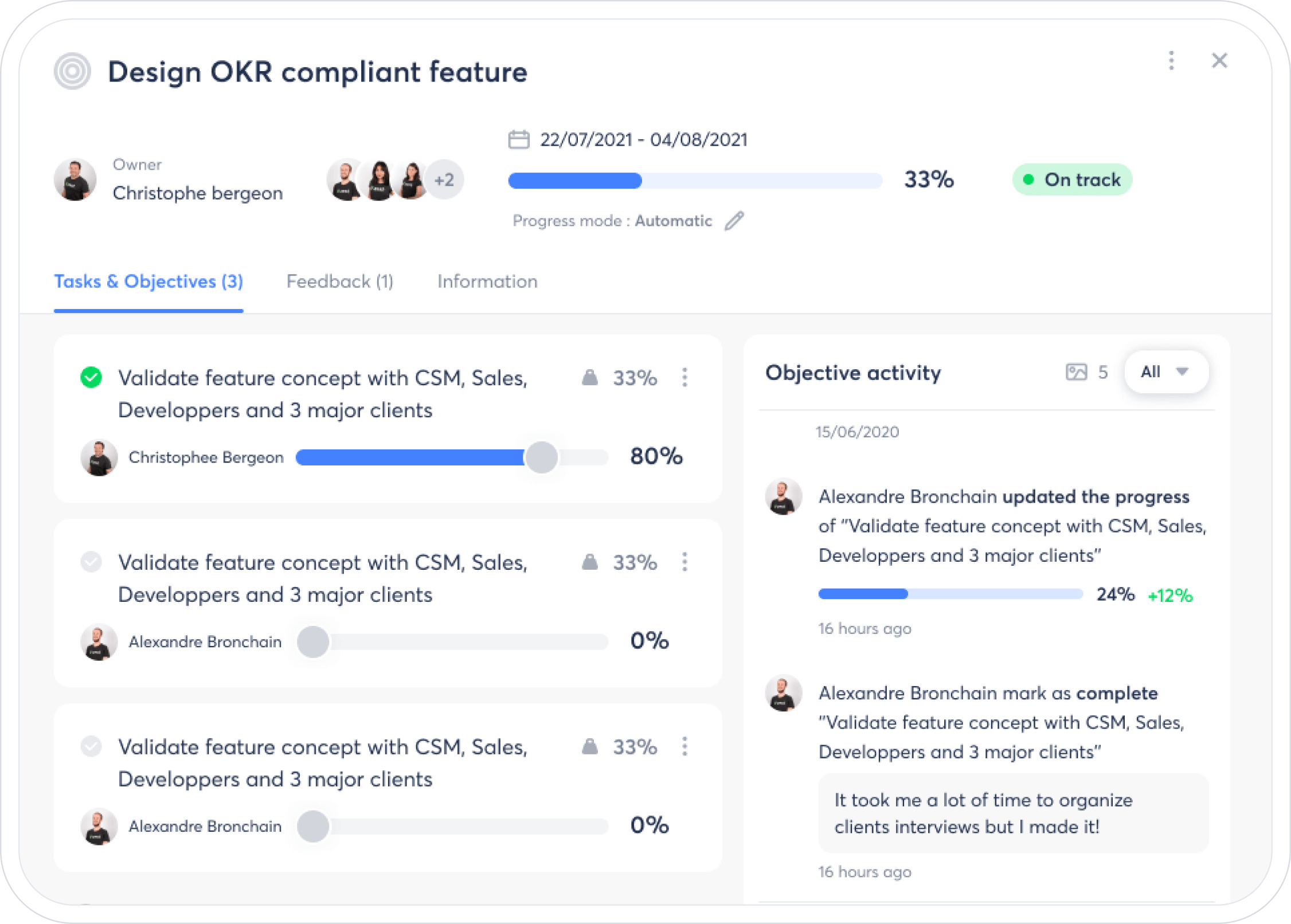
Zest’s real-time dashboard transforms OKR review into a fluid, continuous process. Each employee updates their Key Results progress with the ability to add qualitative comments that contextualize the numbers.
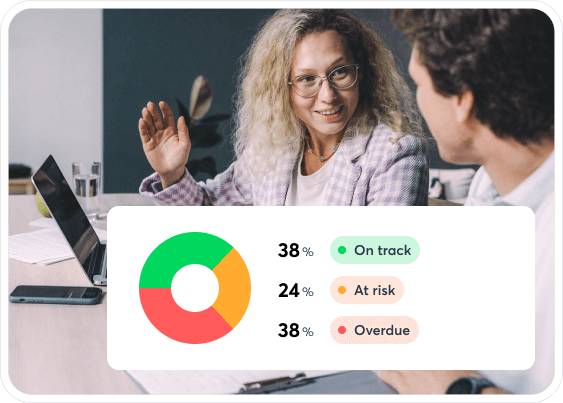
Managers access a consolidated view of all their team’s OKRs, with clear visual indicators (green, orange, red) that immediately draw attention to at-risk situations.
Regular check-ins are facilitated by guided workflows: employees note their progress, identify potential blockers, and can request help from specific colleagues. This ritualization of tracking reinforces execution discipline without increasing administrative burden.
Request a demo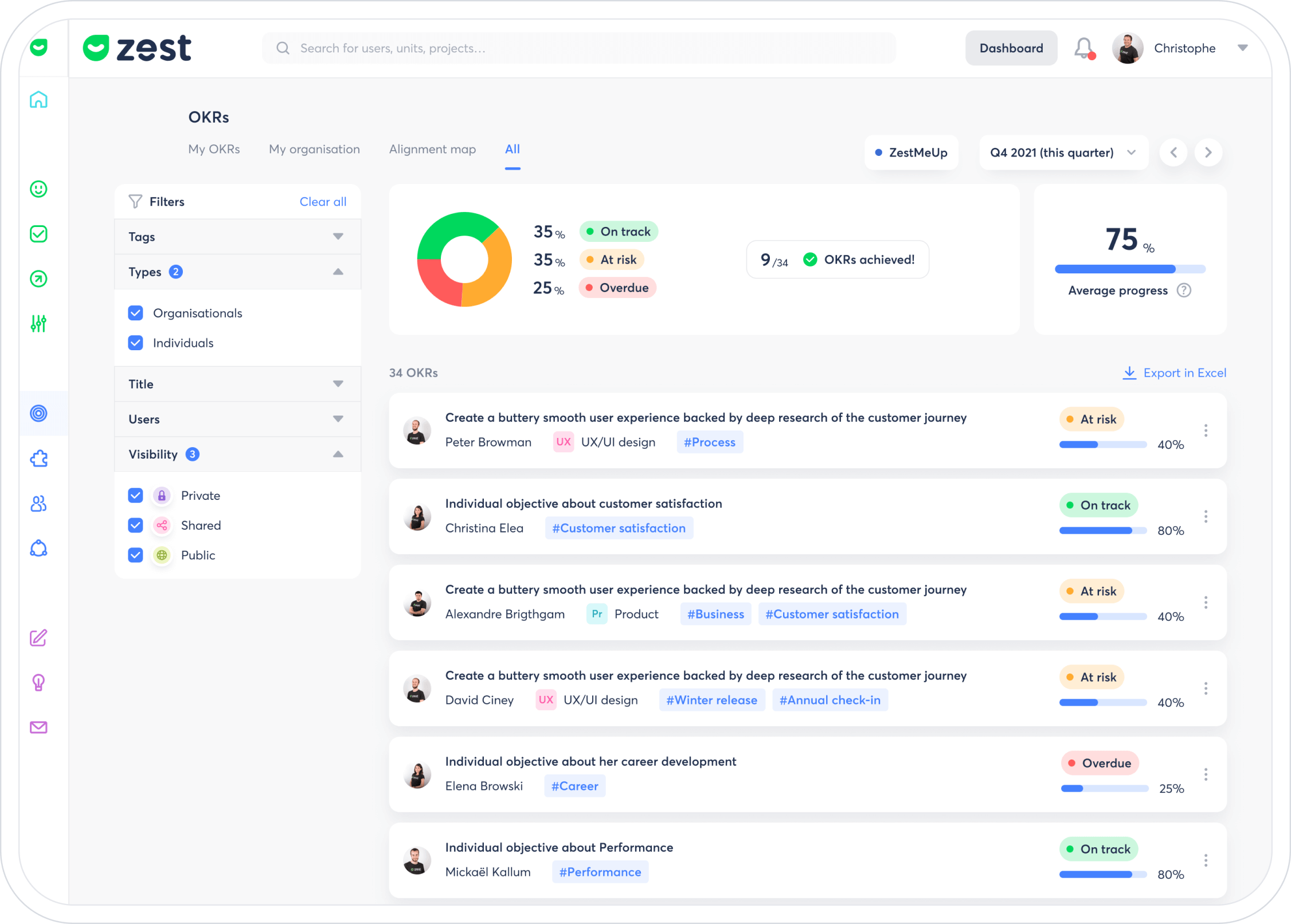
ZestMeUp OKR Software Features
Zest consolidates all the tools necessary for successful OKR methodology deployment throughout your organization.
A Dashboard Presenting Your OKRs
The main dashboard offers an instant panoramic view of all your objectives.
Visual indicators (progress percentages, color codes) enable at-a-glance assessment of overall health. OKRs are sorted by priority, deadline, or status according to your preferences, facilitating daily action prioritization.
Real-Time Tracking of Each Employee’s OKRs
The individual tracking feature gives managers granular visibility into each team member’s progression. Update history enables analysis of progress dynamics: Has a Key Result been stagnant for several weeks? Is trajectory accelerating following corrective action?
Comments and discussions directly linked to each OKR create a contextualized conversation thread. No more searching through emails or instant messages for feedback on a specific objective: everything is centralized and traceable.
Real-Time Tracking of Company OKRs
Access a consolidated strategic view that automatically aggregates team OKR progress toward company OKRs. This overview reveals whether the organization is on track to achieve its quarterly ambitions.
An Intuitive and Scalable Interface
ZestMeUp’s user experience has been designed for rapid adoption by all user profiles, even those unfamiliar with digital tools.
The platform evolves with your needs: start simply with individual OKRs, then progressively activate team OKRs! This scalability ensures the tool remains relevant regardless of your OKR maturity.
A Team Ready to Listen, Help, and Advise
Beyond the tool, Zest supports you through the cultural transformation that OKR methodology adoption represents. Our Customer Success team advises you on deployment best practices, adapts the platform to your organizational specifics, and responds quickly to all your questions.
Our clients say it all
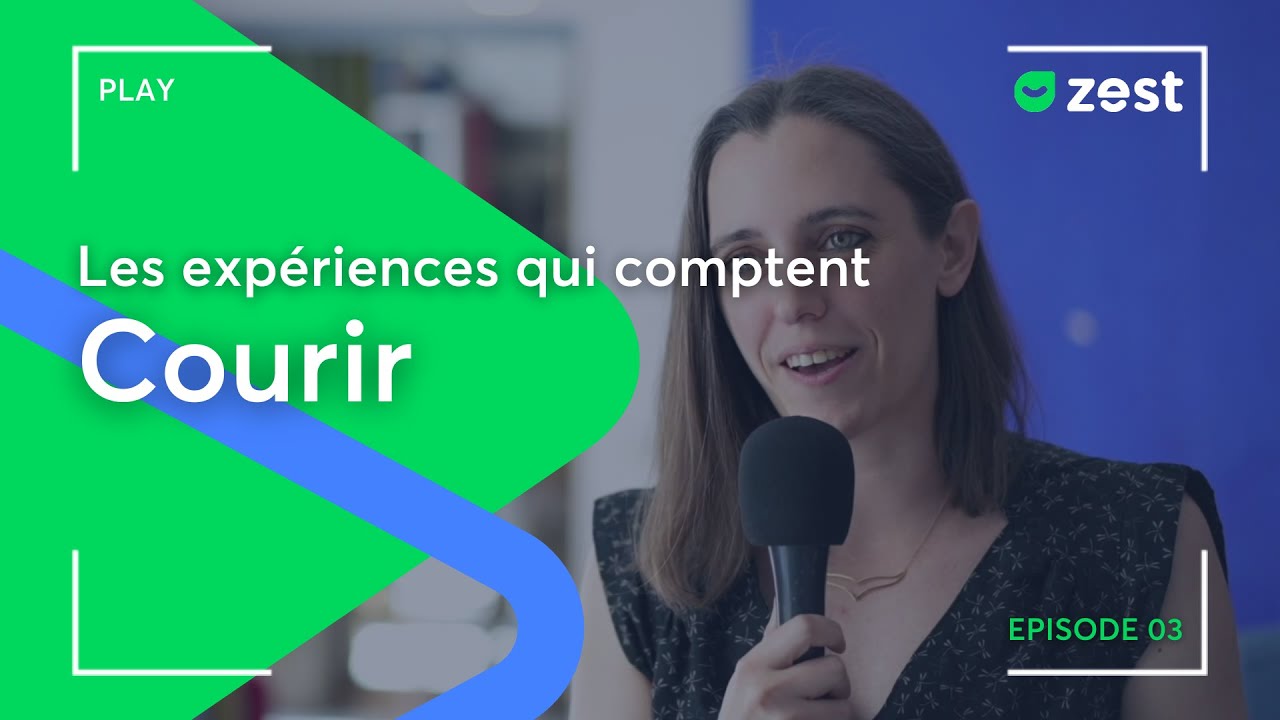
«From an HR perspective, the major advantage is the competence and responsiveness of the Zest teams, which are above average compared to the providers I work with.»
– Laetitia Genot, HR Development Manager, Groupe Courir
Connect Zest to Your Daily Tools
The effectiveness of OKR software also depends on its ability to integrate seamlessly into your existing digital ecosystem. Zest connects natively with the tools your teams already use daily.
Zest integrates with the following solutions:




Request a demo
Q&A
Any questions?
What Example OKR Should You Set for an Employee?
A good individual OKR aligns job responsibilities with team objectives and the employee’s development aspirations. Here are concrete examples by function:
For a sales representative:
Objective: Significantly develop my enterprise client portfolio
Key Result 1: Sign 5 new contracts with companies of 500+ employees
Key Result 2: Reach €150K in recurring revenue in this segment
Key Result 3: Achieve a minimum 90% customer satisfaction rate on my strategic accounts
For a marketing project manager:
Objective: Make our blog the go-to reference in our industry
Key Result 1: Publish 20 in-depth articles each generating 1000+ views
Key Result 2: Reach 5,000 newsletter subscribers
Key Result 3: Generate 300 qualified leads through organic content
For a developer:
Objective: Drastically improve our codebase quality and maintainability
Key Result 1: Increase automated test coverage to 80%
Key Result 2: Reduce technical debt by 40%
Key Result 3: Decrease build time from 15 minutes to 5 minutes
The most important thing is that the Objective inspires and motivates the employee, while the Key Results offer measurable and ambitious progression milestones.
What Example OKR Should You Define for a Company?
Company OKRs translate strategy into concrete and inspiring quarterly objectives for the entire organization. Here are examples for different contexts:
Growth-stage company:
Objective: Significantly accelerate our commercial expansion
Key Result 1: Reach €2M revenue (vs €1.2M previous quarter)
Key Result 2: Recruit 15 new clients in our target segment
Key Result 3: Open commercial presence in 3 new regions
Product centric company:
Objective: Become our users’ preferred product
Key Result 1: Reach an NPS of 65 (vs 48 currently)
Key Result 2: Reduce monthly churn to below 3%
Key Result 3: Increase adoption rate of our new feature to 60% of active users
Company in transformation:
Objective: Permanently anchor a culture of operational excellence
Key Result 1: Reduce average delivery times by 30%
Key Result 2: Reach an eNPS (employee engagement) of 40
Key Result 3: Train 100% of managers in continuous improvement
Company OKRs should be ambitious enough to stimulate the organization while remaining realistic to maintain motivation.
What’s the Difference Between KPI and OKR?
KPIs and OKRs are two complementary management tools that serve different needs:
KPIs (Key Performance Indicators) are recurring health metrics that measure the organization’s continuous operational performance. They answer the question: “How is our business doing?” Examples: monthly revenue, customer satisfaction rate, bugs in production. KPIs are monitored continuously, with no end date, and generally aim to maintain an expected performance level.
OKRs (Objectives and Key Results) are temporary and ambitious goals that target change, significant improvement, or reaching a new milestone. They answer the question: “Where do we want to go?” OKRs have a defined duration (typically one quarter), and once achieved, they’re replaced by new challenges. They deliberately push beyond the comfort zone.
In practice, a company uses KPIs to ensure “the ship is floating” while using OKRs to “choose an ambitious destination and navigate toward it.” KPIs can actually feed into OKR Key Results: if your NPS (KPI) stagnates at 50, you can define an OKR to raise it to 70 by quarter-end.
How Much Does Zest OKR Software Cost?
ZestMeUp pricing is designed to adapt to the size and needs of each organization, from startups to large enterprises.
To learn the precise pricing adapted to your company and discover our current offerings, we invite you to request a personalized demo. Our team will assess your specific needs and propose the most relevant solution.










Allow all cookies
Continue without accepting

Zest respects your privacy
Zest and its partners use cookies or similar technologies and process personal data which may be cross-referenced with information provided as part of our services for the following purposes: to improve your user experience, to carry out audience statistics and studies to improve our offers, to provide you with services tailored to your interests, to display targeted advertising on our site or those of our partners, and to measure the performance of such advertising. Some cookies are necessary for the operation of the site and our services. You can accept, manage your preferences by purpose or continue browsing without accepting.
Cookie settings
Allow all cookies
