HR Performance: Definition, Challenges, Measurement, Key Indicators
HR performance lets you act on your strategic HR data, reveal your talent, and unlock your company’s growth.
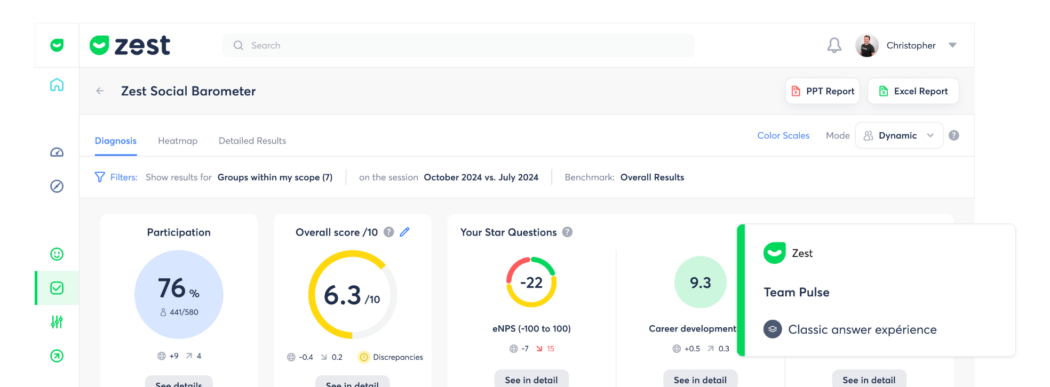
HR performance has become a strategic lever for company growth.
Today, HR departments face several key questions. How do you turn human data into strategic decisions? How do you demonstrate the concrete impact of HR initiatives?
Recruitment, employee engagement, retention, talent development. All these initiatives create value, provided you can measure and track it over time. This is exactly where HR performance comes in.
In an environment where data has become strategic, top performing companies make a clear choice: they rely on reliable HR indicators and advanced analytics tools.
What is HR performance?
HR performance refers to the ability of the human resources function to directly contribute to the company’s strategic objectives.
It rests on a simple idea: HR policy should produce a measurable impact on the company’s overall performance. Human resources becomes a genuine lever of organizational performance.
This affects:
- Recruitment quality
- Employee engagement
- Talent retention
- Skills development
- Team productivity
- Management quality
A high performing HR function does more than manage people. It turns employee experience into a competitive advantage. Are you recruiting the right talent? Are your employees engaged? Do your teams have what they need to perform? To answer these questions precisely, HR teams now need to rely on objective data and ongoing analysis.
What are the challenges of HR performance in the workplace?
The challenges of HR performance are significant today. The job market is changing fast, and so are employee expectations. Companies now face several major challenges.

Attracting top talent
The war for talent is a reality in many industries. A high performing HR function helps you:
- Reduce time to hire
- Improve the quality of applications
- Strengthen your employer brand
Improving team engagement
An engaged employee is more productive, more innovative, and more loyal to the company. According to the BaromEX study conducted by Zest in 2024 among more than 1,200 employees, only 37% of French workers wake up wanting to go to work. HR performance is precisely about activating the right engagement levers.
Retaining employees
The cost of turnover is often underestimated. Replacing an employee can cost 6 to 9 months of salary, according to HR studies. Measuring employee engagement and detecting early warning signs is therefore essential.
Supporting overall company performance
Executive leadership now expects HR teams to justify their decisions with measurable data. This means demonstrating, with reliable data:
- The impact of a management program
- The effectiveness of a recruitment policy
- The relevance of a retention strategy
HR performance therefore depends on the ability to turn human data into strategic insights, which requires reliable, usable data.
How do you measure HR performance?
Measuring HR performance starts with a structured approach. You cannot manage what you do not measure. The first step is to define clear HR objectives aligned with the company’s strategy.
You need to set up a tracking system based on:
- Precise HR indicators
- Regular employee surveys
- Reliable operational data
- Shared analytics tools
Because HR performance relies on continuous employee listening and real time analysis of key indicators, HR software like Zest lets you centralize and analyze this data in real time.
What are the key indicators of HR performance?
To measure the impact of HR initiatives, your company needs to define reliable, strategic HR indicators. These form the foundation of any strategic management approach. The most common key indicators include:

Turnover rate
Turnover measures the percentage of employees who leave the company over a given period. It is calculated using the following formula:
Turnover rate = (Number of departures over a given period / Average headcount over the period) x 100
To help you:
- Number of departures = Total number of employees who left the company
- Average headcount = (Headcount at the start of the period + Headcount at the end of the period)/2
Some benchmarks to help you analyze your company’s turnover rate:
- Under 10%: turnover under control
- 10 to 15%: a zone to watch
- Over 15%: high turnover
High turnover can point to a lack of employee engagement, a management issue, and/or unsatisfactory working conditions. Averages vary widely from one industry to another. Retail, for example, is known for high rates of around 25 to 35%.
Don’t stop at the overall rate. You can also analyze:
- Turnover by team
- Turnover among new hires
- Turnover among key talent
Absenteeism rate
The absenteeism rate helps assess employee wellbeing and working conditions. It is calculated using the formula:
Absenteeism rate = (Number of days absent / Number of theoretical working days) x 100
Where:
- Number of days absent: total days of absence over the period (illness, workplace accidents, exceptional leave, etc.)
- Number of theoretical working days: the total number of days that should have been worked by all employees
It can be analyzed as follows:
- Under 3%: low level
- 3 to 5%: normal level
- Over 6%: warning sign
Absenteeism can point to stress, work overload, and/or a lack of recognition.
These indicators are most meaningful when analyzed over time and compared across teams.
Employee engagement rate
The employee engagement rate measures how attached employees feel to their company. It is calculated as follows:
Employee engagement rate = (Number of engaged employees / Total number of respondents) x 100
An engagement score above 70% is generally considered good.
Below 50%, the risks are significant:
- Lower productivity
- Absenteeism
- Voluntary departures
Employee experience should be measured regularly to detect early warning signs and prevent disengagement.
Average time to hire
Average time to hire refers to how long it takes to recruit an employee.
As a general guide:
- 30 to 45 days: solid performance
- Over 60 days: the process needs improvement
A recruitment process that takes too long can affect team productivity.
How do you analyze HR performance?
Collecting HR data is the first step. The second is knowing how to analyze it to draw the right conclusions. This is how HR data becomes concrete decisions.
 Identify trends

How an indicator evolves over time often reveals important trends, for example:
– Engagement declining gradually
– Turnover rising within a team
– An increase in absenteeism
These early warning signs need to be spotted quickly so you can react fast.
 Cross-reference data

Analysis becomes truly powerful when you combine multiple indicators. For example, you might find:
– Low engagement combined with high turnover
– Work overload combined with high absenteeism
– Low recognition combined with significant demotivation
These correlations help identify the root causes of HR issues.
 Give employees a voice

Quantitative data should be complemented by employee listening tools that provide qualitative feedback:
– Employee surveys such as Pulse surveys
– Social barometers
– Continuous feedback through tools like 360 reviews
Together, these elements help you understand what teams actually experience day to day.
How do you manage HR performance day to day?
Managing HR performance is not just about producing an annual report. It needs to be continuous and actionable.
1
Set up regular surveys
Annual reviews are often not enough to gather data on employee experience because they are too spaced out. You risk detecting early warning signs too late. The most successful organizations combine short, frequent surveys with continuous feedback and real time engagement indicators.
2
Involve managers
Managers play a key role in HR performance. They need access to their teams’ key indicators, they need to understand the results, and they need to act quickly. This means training them on the tools you use across your organization.
3
Rely on HR software
HR software lets you:
- Prioritize HR initiatives
- Track the performance indicators you have defined for your company
- Measure employee engagement
- Analyze employee experience
- Detect early warning signs
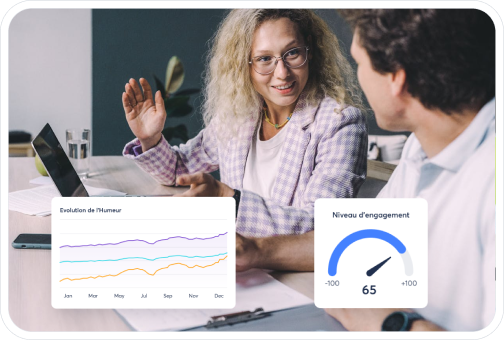
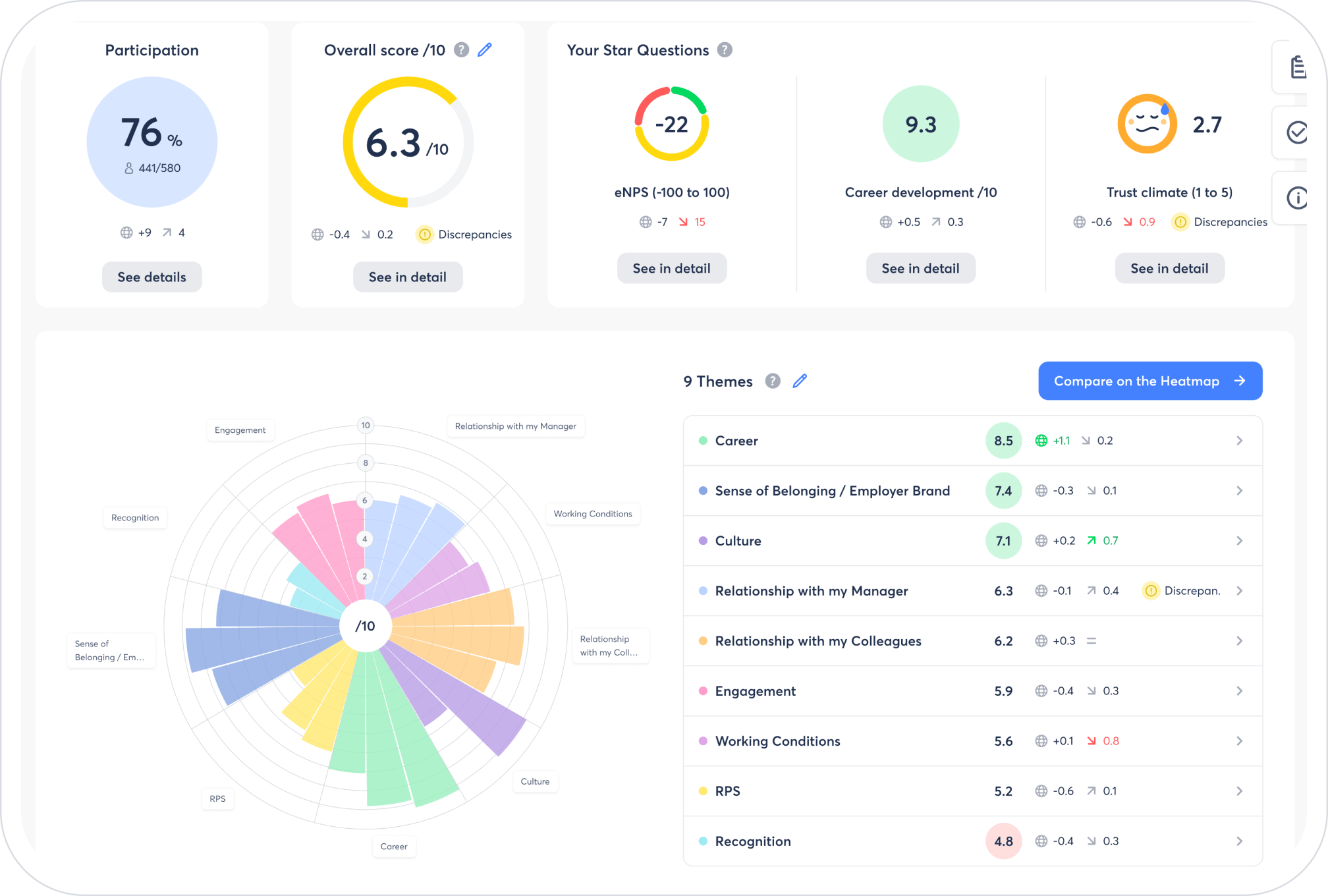
HR software like Zest centralizes and manages all your HR data, both qualitative and quantitative, in clear, real time dashboards. This gives HR teams a reliable, ongoing view of workplace climate, engagement, and performance.
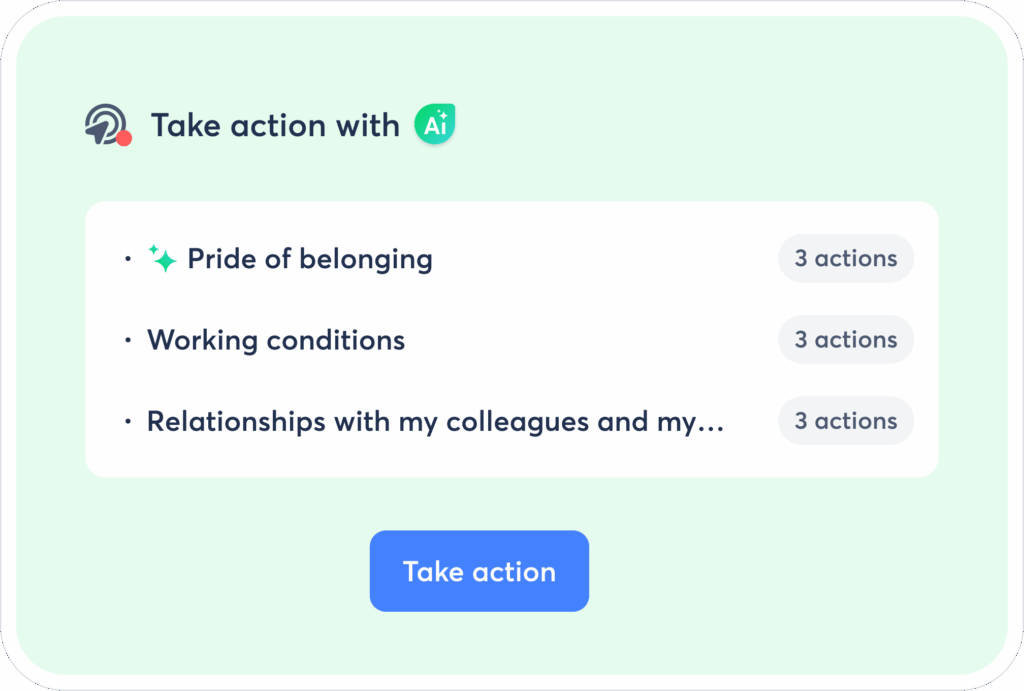
But the real value goes further. With AI, Zest quickly analyzes feedback, detects early warning signs (psychosocial risks, disengagement, turnover risk, and more), and surfaces the key themes.
More than that, Zest doesn’t just analyze. The platform turns these insights into concrete recommendations and actionable plans, letting HR teams and managers move straight from data to business impact.
By turning HR data into actionable insights, companies can reveal their talent and accelerate their collective performance.
How do you showcase HR performance?
One last challenge, and not a minor one: the HR function also needs to showcase its impact to leadership and managers.
Communicating results
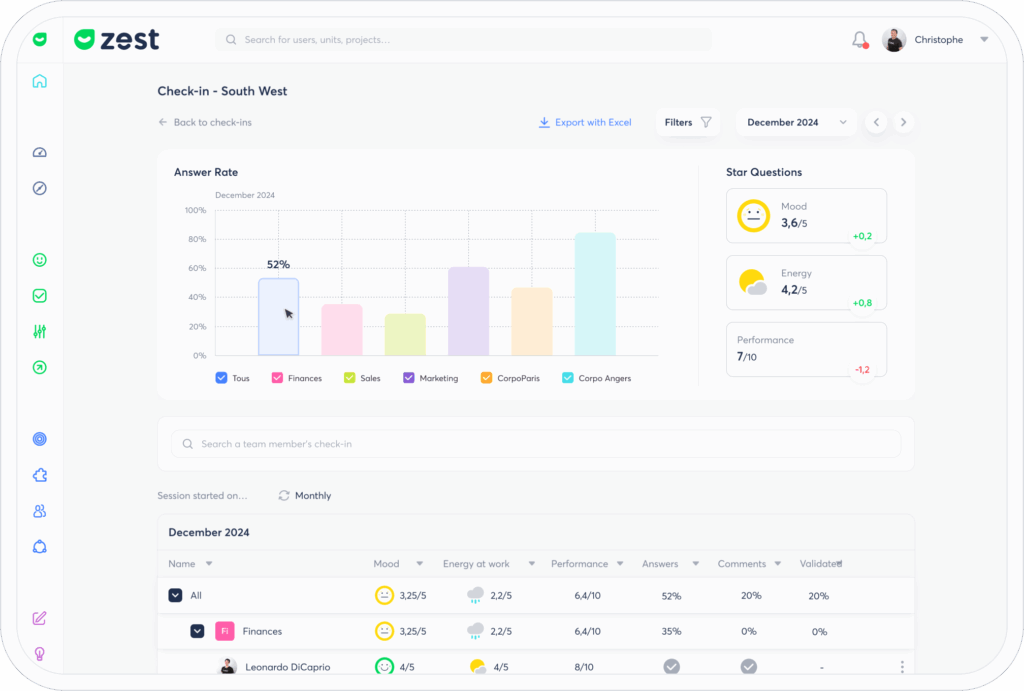
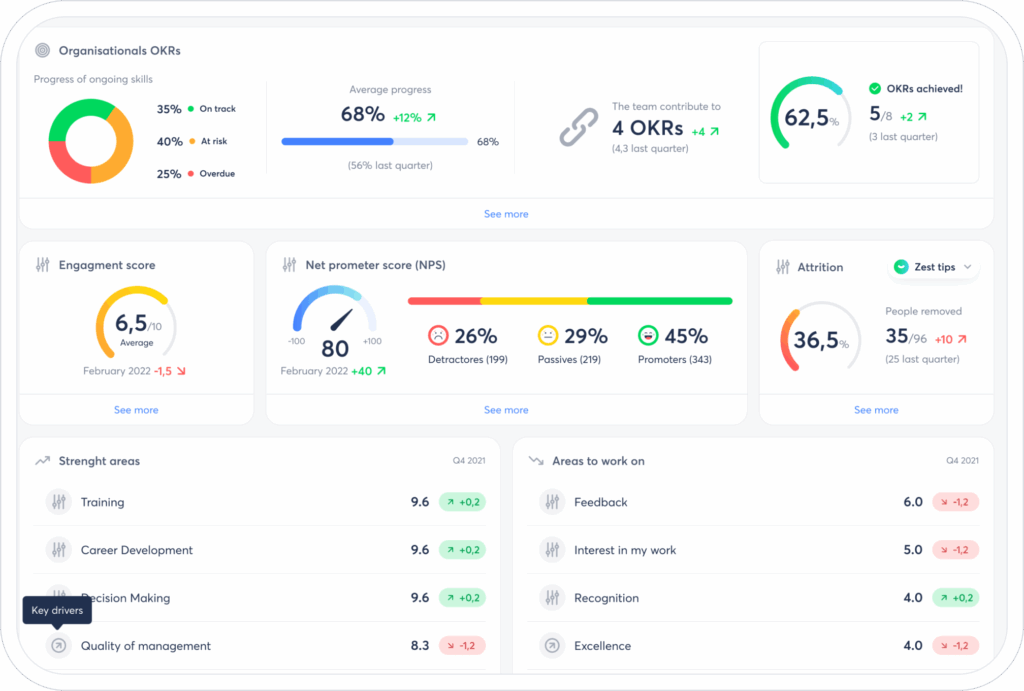
HR teams need to regularly share key indicators, progress made, and actions taken internally. Zest software lets you automate the creation of dashboards that bring together your main HR KPIs and how they evolve, making internal communication easier. Interview campaign summaries, the Engageomètre summary, and your key indicator overview page are all tools available to make results easier to read.
Demonstrating business impact
HR performance needs to be tied to company results. Lower turnover and improved engagement drive higher productivity. By cross-referencing your organization’s various KPIs, you strengthen the strategic credibility of the HR function.
Turning data into decisions
HR data should not stay theoretical. It needs to lead to concrete actions, clear priorities, and lasting change.
Modern employee listening solutions like Zest now let you act on strategic HR data, reveal talent, and unlock company growth.
Our clients say it best
« Having data, and being able to explain why we’re putting a given policy in place, gives real legitimacy to HR policy and strong support from leadership for what we implement. »
– Marie-Karine Tibi, HR Director, Celio

Allow all cookies
Continue without accepting

Zest respects your privacy
Zest and its partners use cookies or similar technologies and process personal data which may be cross-referenced with information provided as part of our services for the following purposes: to improve your user experience, to carry out audience statistics and studies to improve our offers, to provide you with services tailored to your interests, to display targeted advertising on our site or those of our partners, and to measure the performance of such advertising. Some cookies are necessary for the operation of the site and our services. You can accept, manage your preferences by purpose or continue browsing without accepting.
Cookie settings
Allow all cookies
