Attractiveness, talent retention, engagement, performance: employer brand has become an essential HR challenge and a key competitive advantage for companies.
In France, 67% of candidates would accept a lower salary to join an organization with a strong online image. On the other hand, more than a third would refuse to join a company with a poor reputation (LinkHumans). So what exactly is employer brand? How do you build, develop and effectively promote it? Here’s everything you need to know.
Employer brand: what are we really talking about?
Employer brand: definition
Employer brand refers to the image and reputation a company builds and promotes as an attractive employer. It covers company culture, values and the employee experience put in place to attract and recruit the best candidates externally, and to retain and engage talent internally. The concept was created in 1990 by Simon Barrow, chairman of People in Business. It’s about turning your company into a brand with real impact.
This is no small challenge. While two thirds of companies deploy an employer brand strategy, only a third of employees actually perceive it (Welcome to the Jungle barometer, 2023).
The 4 pillars of employer brand
Internal company image
This refers to how employees perceive their workplace. A stimulating culture, opportunities for professional growth, an inclusive work environment and strong interpersonal relationships all help project an engaging image.
External company image
This is how your company is perceived from the outside: by candidates, industry professionals, clients and investors. This perception is shaped in particular by the company’s reputation, its online presence, its CSR (corporate social responsibility) initiatives, its visibility on the job market and its media coverage.
Company values
Embodying your company values and your DNA sends a powerful signal that benefits your employer brand enormously. Your values shape your company culture, guide your decisions and actions, and reflect your key commitments, influencing how your organization is perceived both internally and externally.
Company strategy
Finally, your vision, mission and long-term objectives are also part of your employer brand. A clear company strategy helps employees find meaning in their work and feel invested in the company’s success. In short, it makes them more engaged and more productive.
With Zest, use the annual HR survey to strengthen your employer brand!
Employer brand strategy: what’s at stake?
Attract the best candidates
In a context of fierce competition for talent, a positive employer brand can increase highly qualified applications by 50% (LinkHumans). The stronger your brand recognition, the easier it becomes to naturally target, attract and recruit the right profiles, without excessive investment: future talent who are already engaged and share your company’s values and DNA.
Retain your current talent
A strong employer brand also promises a high eNPS score. Your employees are your best brand ambassadors. It’s up to you to win them over and boost their engagement, encouraging them to share their positive experience and recommend you on social media and review sites.
Zest helps you effectively understand your employees’ expectations and needs, boosting their engagement and improving your employee experience.
How do you build and develop your employer brand?
Get leadership involved
HR can’t build and roll out your employer brand strategy alone. It needs to be embodied by everyone. Leadership and managers must understand its importance and commit to supporting initiatives that strengthen your company’s image and reputation.
Gather employee feedback
How do your employees perceive your company and its image? Involve them in the process: with Zest, survey their sentiment, run regular feedback sessions, and use pulse surveys to understand what’s working and what could be improved in your company culture. Then act on it.
Work on your values
Identify and clearly communicate your employer brand platform, your values and your identity (vision, mission, why) and your key message to define your positioning.
Stay consistent
Make simplicity your best ally. Make sure your brand image and message stay consistent across all your communication channels. Your employer brand shouldn’t lie. It needs to reflect what your employees actually experience in terms of quality of work life, work-life balance, professional development, CSR commitment and more.
Tie KPIs to your employer brand
Define key performance indicators (KPIs) to measure how effective your employer brand strategy is. These might include employee engagement and satisfaction rates, turnover rate, eNPS, or your company’s social media following. Note that this strategy can also be structured around a precise OKR approach.
Identify your brand ambassadors
These are engaged, enthusiastic employees who embody your company’s values and genuinely want to share their positive experience with future candidates. Encourage them to speak up and recommend you online. Employee advocacy is a powerful tool.
Zest is the promise of an impactful, distinctive employer brand: strengthen your reputation and recruit more easily.
How do you improve your employer brand?
Want to boost your employer brand? Start by optimizing your online image. Make sure your website reflects your DNA and your employee experience. It’s often the first point of contact potential candidates have with your company.
Then strengthen your internal communication (starting with onboarding) and your online presence. Share your successes, company events and in-depth articles. And don’t forget to address what matters most to current talent: CSR, quality of work life, diversity, inclusion, purpose and learning opportunities.
Employer brand: mistakes to avoid
Employer brand isn’t just a communication tool. Earn the trust of future candidates and keep the trust of current employees by regularly demonstrating the real impact of your communication efforts, provided they’re already backed by tangible results. Authenticity is key.
Finally, don’t overlook the offboarding phase at the end of the employee journey. It’s just as crucial as onboarding when it comes to employee experience, reputation and employer brand.
How do you promote your employer brand?
Externally
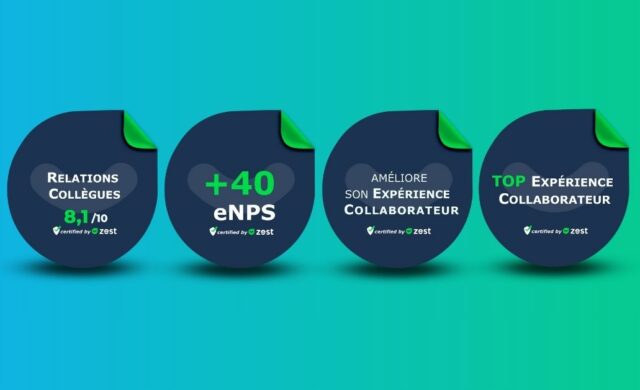
Promote it externally with tangible proof points to attract future talent: testimonials, eNPS scores, HR labels. Showcase them on your company’s social media and on your dedicated careers page.
Internally
Likewise, communicate internally. Leadership, quality of work life, work-life balance, benefits, professional development and more: communicate on all the pillars, initiatives and services that make up your employee experience.
Examples of successful employer brands
Employer brand can be measured. There’s even a ranking of the best digital employer brand strategies, published on specialized sites like Glassdoor. Among them are a few Zest clients: Chanel, Adeo and Hermès.
Q&A
Any questions ?
Who is responsible for employer brand within a company?
Responsibility for employer brand can fall to different people depending on the company’s structure. It can be managed centrally by a specific department, often HR or a dedicated internal communications and marketing team. Alternatively, it can involve collaboration across several departments, including HR, marketing and employees themselves.
What’s the purpose of an employer brand?
The purpose of an employer brand is to create a positive image of the company as an employer, in order to attract and retain the best talent. It aims to shape how the company is perceived on the job market and to communicate its value proposition to both potential and current employees.
What are the limits of employer brand?
The limits of employer brand include an inconsistent or frustrating candidate experience, unfulfilled promises, and a disconnect from the rest of the company. An employer brand can’t mask a company’s negative aspects. It needs to be aligned with internal reality to be effective.
What features does Zest offer to improve my employer brand?
Zest provides comprehensive support to strengthen your employer brand by helping you define your HR and management strategy. We also help you showcase your efforts by earning Zest HR labels, validated by a committee of specialists.
Zest and its partners use cookies or similar technologies and process personal data which may be cross-referenced with information provided as part of our services for the following purposes: to improve your user experience, to carry out audience statistics and studies to improve our offers, to provide you with services tailored to your interests, to display targeted advertising on our site or those of our partners, and to measure the performance of such advertising. Some cookies are necessary for the operation of the site and our services. You can accept, manage your preferences by purpose or continue browsing without accepting.

 Internal company image
 External company image
 Company values