QWLC: Challenges and Best Practices for Improving Quality of Life at Work
QWLC is a holistic concept aimed at improving wellbeing at work and employee fulfillment. It means giving people the best conditions to thrive in their roles, safely, while supporting a healthy work-life balance.
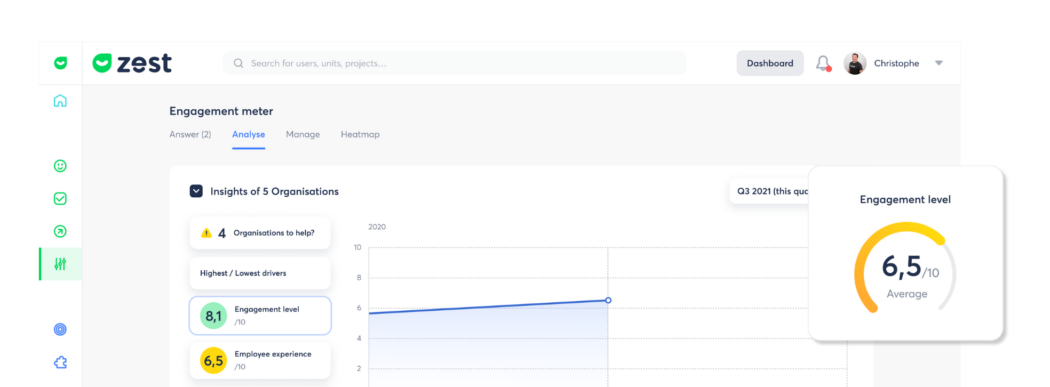
Meeting your talent’s psychological needs at work is a priority at Zest!
Quality of Life at Work: what are we talking about?
How can QWLC be improved, and what exactly is QWLC? Quality of Life at Work (QWLC), covers all the conditions in which employees carry out their work within an organization: atmosphere, company culture, sense of purpose, feeling of involvement, degree of autonomy and empowerment, equality, the right to make mistakes, recognition and appreciation. The concept was developed in France as early as 1973, notably with the creation of the National Agency for the Improvement of Working Conditions (ANACT).
A QWLC approach is a comprehensive, proactive strategy covering multiple dimensions (social climate, management, health) that companies deploy to optimize working conditions for their employees. One outcome of an effective QWLC policy is its positive impact on the performance of individuals, teams and the company as a whole.
According to the 2013 National Interprofessional Agreement, “quality of life at work focuses first on the work itself, on working conditions, and on whether or not they allow employees to do good work within the organization.” It’s worth noting that France hasn’t always treated employee wellbeing, health and safety as major, essential issues for companies. That shift wouldn’t come until the 21st century.
How can QWLC be improved with Zest?
There are many areas and levers for improving QWLC. They involve working conditions, employees’ ability to act and express themselves, and the content of the work itself. Not so simple!
Zest lets you quickly assess QWLC within your organization, identify pain points and priority areas, and test action plans using a collaborative, sustainable approach.
Improving QWLC means building in listening (through a Pulse or 360 feedback culture), dialogue, participative management and co-construction to bring your teams on board. Measure, analyze and act effectively with our employee engagement software!
Improving QWLC in your company in 5 steps
1
Conduct a QWLC diagnostic
The first, essential step: give employees a voice, involve them, and check their actual expectations. Assess the situation and how employees perceive the QWLC policy, then establish an objective diagnosis.
Our tip: in Zest, the survey template library includes a QWLC survey template designed by our team of occupational psychologists. It can be adapted to each company’s specific needs and gives you a complete initial snapshot.
2
Set clear objectives to optimize QWLC
Second step: pinpoint exactly what needs to improve in terms of employee wellbeing, social climate, work-life balance, or skills.
Our tip: co-build these objectives with the various stakeholders in a collaborative way, to bring the whole organization on board.
3
Roll out a concrete action plan
Our tip: take an experimental approach on a small scale first, so you can test it and refine it with agility. This test-and-learn approach helps you stay efficient and responsive. The focus should always be on your employees’ feedback, since these actions are designed for them.
4
Report back to employees on the QWLC approach
Our tip: sharing progress and results with employees helps maintain their involvement and engagement, and gives you a chance to gather their feedback.
5
Adapt and sustain the QWLC approach
Our tip: embed the approach for the long term and build it into your company’s regular rituals, so your QWLC policy keeps evolving and improving over time. Remember to review the actions taken on a regular basis.
How can you measure QWLC with Zest?
 QWLC indicators

Many indicators (such as absenteeism rate, turnover and engagement) help measure the quality of a company’s QWLC policy. They vary depending on company size, sector and business strategy. So how do you find your way through it all? What matters is setting up an ongoing, active listening system to diagnose issues, identify strengths, spot early warning signs and find effective solutions. That’s exactly what Zest offers.
 The social barometer

The social barometer (or annual HR survey) makes it easy to get a clear picture of employees’ overall sentiment toward the organization, or on a specific topic such as a relocation or restructuring. It gives you a precise view of employee motivations, expectations and feelings, particularly regarding the QWLC policy at a given point in time.
 Annual reviews

The annual performance review formalizes the conversation between manager and employee about performance, objectives and aspirations for the past and coming year. It’s also a chance to gauge how effective the QWLC policy is and how it’s perceived on the ground.
 Surveys and questionnaires

Finally, surveys on specific topics can be launched regularly or on an ad hoc basis, across all or part of the company, to measure in depth how QWLC has improved following the actions put in place, among other things.
What are the 6 dimensions of QWLC?

Improving QWLC and social climate
Create an environment that helps employees thrive, where they feel supported and respected. A positive social climate and good interpersonal relationships build trust, communication, collaboration and solidarity within the organization.
Job content
Design varied, engaging roles that let employees use their skills and feel that their contribution to the company matters.
Enriching, stimulating, meaningful work strengthens employee motivation and engagement.
Health and wellbeing at work
Pay close attention to employees’ physical and mental health, to reduce psychosocial risks (PSR) and prevent exhaustion or burnout.
Protect their wellbeing through a quality physical environment: preventing occupational risks, managing stress, preventing musculoskeletal disorders (MSDs), providing access to breaks and moments of relaxation, and supporting policies that promote work-life balance.
Skills and career development
Support employees’ professional growth and fulfillment. Provide training opportunities, career progression and, where needed, reskilling programs. This helps employees feel more valued and more motivated as they grow within the company.
Workplace equality and inclusion
Promote equality between men and women, along with the inclusion of people from diverse backgrounds, through fair recruitment policies and equal pay for work of equal value, for example, as well as through measures to combat discrimination and actions that support diversity and inclusion within the company.
Optimizing QWLC through management style
Help strengthen employees’ engagement, sense of belonging and trust in the company through participative, caring and empathetic leadership.
Managers play a key role in rolling out and improving QWLC: by staying attuned to their teams’ needs, encouraging participation and initiative, giving constructive feedback, and acting as a source of support in solving problems.
Promoting and improving QWLC : what’s at stake?
A successful QWLC policy brings many benefits, for individuals (self-esteem, recognition), for teams (cohesion, team spirit) and for the company as a whole (higher performance):

Build loyalty, engagement and satisfaction
93% of employees in France are not engaged, according to the 2021 Gallup study. Yet satisfied, engaged employees are happier, more motivated, more productive and more loyal to their company. Disengagement, on the other hand, carries a significant cost, estimated at $8.8 billion. Retaining talent, sustaining engagement, and giving employees a sense of purpose and recognition are essential.
Prevent absenteeism and psychosocial risks
Employees who are happy at work are less prone to stress, burnout, absenteeism, sick leave and resignations. Disengaged employees are likely to be absent 37% more often than engaged employees. A wellbeing policy can reduce absenteeism rates by 25% (Chapman Institute).
Improve QWLC, performance and productivity
According to a study by MIT and Harvard University, employees who are fulfilled and in good health are 31% more productive. Improving QWLC and working conditions boosts innovation, creativity and internal efficiency, with a direct positive impact on overall performance.
Strengthen employer brand
QWLC has a direct impact on employer brand. A strong employer brand makes a company more attractive on the job market and helps improve talent retention, while also meeting the new expectations of employees and younger generations.
Employer obligations regarding QWLC and health
Every company is required to look after its employees’ health. While “Quality of Life at Work” (QWLC) has no precise legal definition, several legislative and regulatory texts nonetheless emphasize employee wellbeing: the obligation to prevent occupational risks (Article L4121-1), the right to disconnect (Article L2242-8), monitoring of employees’ health (Article L4622-2), and the prevention of moral and sexual harassment (Articles L1153-1 to L1153-6).
Webinar: How to improve QWLC within your company
- Set up a continuous listening system: Introduce regular pulse surveys (weekly, monthly, quarterly) and one-to-one meetings to track mood and workload, and quickly spot signs of distress, so you can adjust QWLC actions with agility.
- Encourage physical activity to reduce sedentary behavior: Promote at least 30 to 40 minutes of moderate exercise a day (through inter-department sports challenges, awareness campaigns or financial support for gym memberships) to limit the risks linked to sitting for more than 8 hours and to improve productivity and wellbeing.
- Train managers to spot and refer: Help managers recognize changes in behavior (boreout, brownout, signs of stress) and create a safe space for open conversation. Their role: listen and refer employees to the right professionals (sophrologists, psychologists), without trying to replace them.

Trends and developments in improving QWLC
QWLC : the concept evolved in 2021 to focus more on employees, incorporating their working conditions, the content of their work and how they perceive it. The conversation has shifted away from physical amenities (the famous foosball table) and toward overall wellbeing.
In practice, this means shining a light on core performance-related topics, such as management practices, career paths, how change is managed, and work-life balance.
Our clients say it best
« The reliability and objectivity of the tool were two key criteria in our selection process. Designed by occupational psychologists, it keeps offering features that are ever more relevant to real workplace challenges. »
– Mathilde Elzière, Associate Director, Resoneo

Frequently asked questions about QWLC
Have questions?
Is QWLC mandatory?
In France, there’s no specific law requiring companies to implement a QWLC approach. However, several legislative and regulatory texts emphasize employee wellbeing, such as the obligation to prevent occupational risks (Article L4121-1), the right to disconnect (Article L2242-8), monitoring of employees’ health (Article L4622-2), and the prevention of moral and sexual harassment (Articles L1153-1 to L1153-6).
What topics does QWLC cover?
QWLC is a broad concept covering a wide range of areas: workplace relationships and social climate, job content, health at work, skills and career development, equality for all, participative management and engagement.
What are the employer’s obligations regarding quality of life at work?
Employers have significant obligations when it comes to Quality of Life at Work (QWLC) in France. These obligations aim to protect employee health and wellbeing, prevent occupational risks, and foster a healthy work environment where employees can thrive.
When was QWLC first defined?
QWLC was first defined in the 2013 National Interprofessional Agreement. The concept was later refined in the 2015 Rebsamen Law, which introduced the Mandatory Annual Negotiations (NAO). In 2020, the official term became QWLC, which was written into the French Labor Code in 2022 under the phrase “quality of life and working conditions.”
When does QWLC Week take place?
QWLC Week takes place every year in June. In 2023, it ran from June 19 to 23.
More news with Zest

Mastering the professional development interview: key strategies and best practices
The professional development interview is more than a legal requirement—it’s a strategic tool for building skills and boosting talent retention.
In this article, discover five key levers to make these conversations truly impactful.

fixed-term contracts and annual reviews: 5 keys to a successful evaluation
Annual performance reviews must be applied to fixed-term contract employees once the company has formalized them for all staff, in order to avoid unequal treatment and legal risks. These interviews, structured around realistic objectives, demonstrated skills, and a clear evaluation framework, provide tangible benefits both for the company (increased productivity, team cohesion, reduced legal risks) and for the employee (skills recognition, identification of training needs, growth opportunities).

The annual review for apprentices: a valuable HR opportunity too often overlooked
Annual reviews for apprentices are a powerful HR lever to develop talent, strengthen engagement, and promote managerial equity. Discover how this strategic practice improves the retention of work-study students and transforms your company into a true springboard for tomorrow’s skills.
Allow all cookies
Continue without accepting

Zest respects your privacy
Zest and its partners use cookies or similar technologies and process personal data which may be cross-referenced with information provided as part of our services for the following purposes: to improve your user experience, to carry out audience statistics and studies to improve our offers, to provide you with services tailored to your interests, to display targeted advertising on our site or those of our partners, and to measure the performance of such advertising. Some cookies are necessary for the operation of the site and our services. You can accept, manage your preferences by purpose or continue browsing without accepting.
Cookie settings
Allow all cookies
