Pulse survey software: catch weak signals in time
Disengagement doesn’t send a warning. The Pulse does.
Between two barometers, teams change. A manager struggling, a reorganization poorly received, a wave of departures on the horizon: these signals exist long before they show up in the annual figures.
Zest detects them, raises the alert, and equips the manager to act before it’s too late.
Request a demo










Disengagement doesn’t send warnings.
Companies that measure employee engagement once a year get a precise snapshot at a single point in time. But between two campaigns, the reality on the ground keeps evolving: a key manager leaves, a team goes through a difficult reorganization, absenteeism rises at a site. These signals exist long before they become visible in the figures. They simply never surface, because no one asked the question at the right moment.
The problem isn’t the annual measurement. It’s the blind spot between two campaigns.
A Pulse survey doesn’t replace the employee engagement barometer. It fills in what the barometer can’t do: trigger an HR alert within 7 days on a struggling team, not in 12 months.
Pulse survey vs employee engagement barometer: what’s the difference?
The Pulse isn’t a mini barometer. It’s a continuous monitoring tool, designed so the manager can act, not just so HR can measure.
| Method Engagement Barometer | Method Pulse Survey | |
|---|---|---|
| Frequency | Annual / biannual | Monthly / weekly |
| Number of questions | 15 to 30 | 3 to 10 |
| Objective | Overall diagnosis | Weak signal, quick response |
| Main recipient | HR Director, executive committee | Manager, HRBP |
| Output | Full report | Alert + real time dashboard |
Two complementary approaches to listening to your teams with Zest.
What does Zest actually do?
Create lightweight surveys
An effective Pulse survey fits into 3 to 10 questions. Not because of a technical constraint, but because brevity is what guarantees a high participation rate over time.
Zest offers a library of Pulse survey templates designed for specific moments:
- Onboarding follow up at day 30, 60, 90
- Return from extended leave
- Post reorganization
- Return from maternity or medical leave
- Managerial satisfaction
- Organizational transformation
- Psychological safety
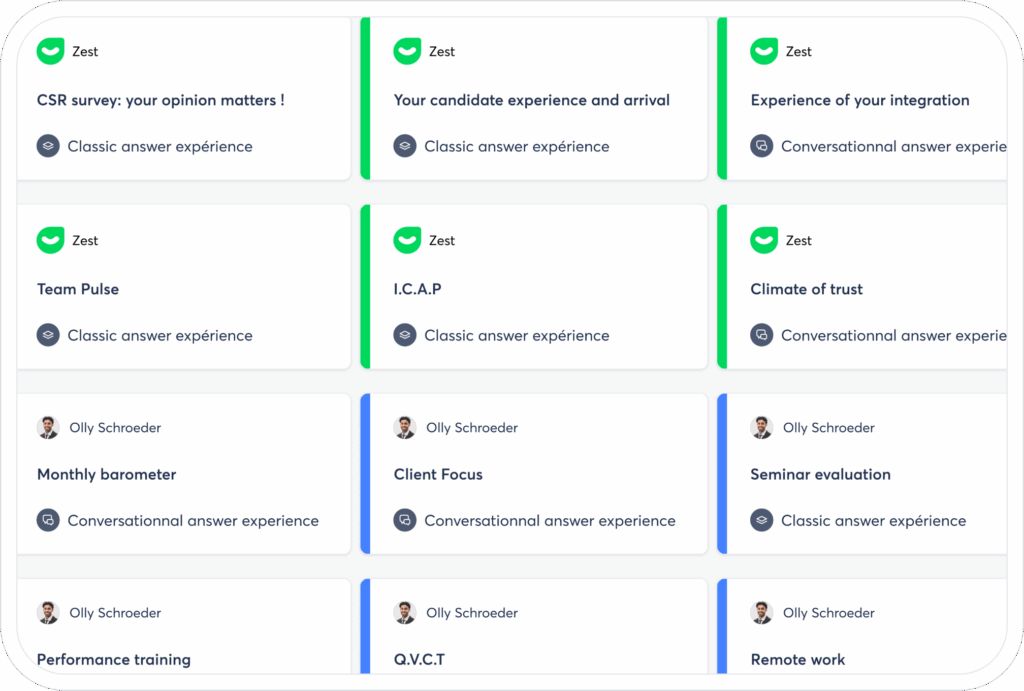
Each template is ready to deploy and can be adapted in minutes.
Recurrence, anonymity, distribution scope, and results sharing can all be configured independently for each campaign. A post reorganization survey doesn’t have the same anonymity requirements as an onboarding follow up. Zest adapts to the context, not the other way around.
Distribute at the right time, to the right scope
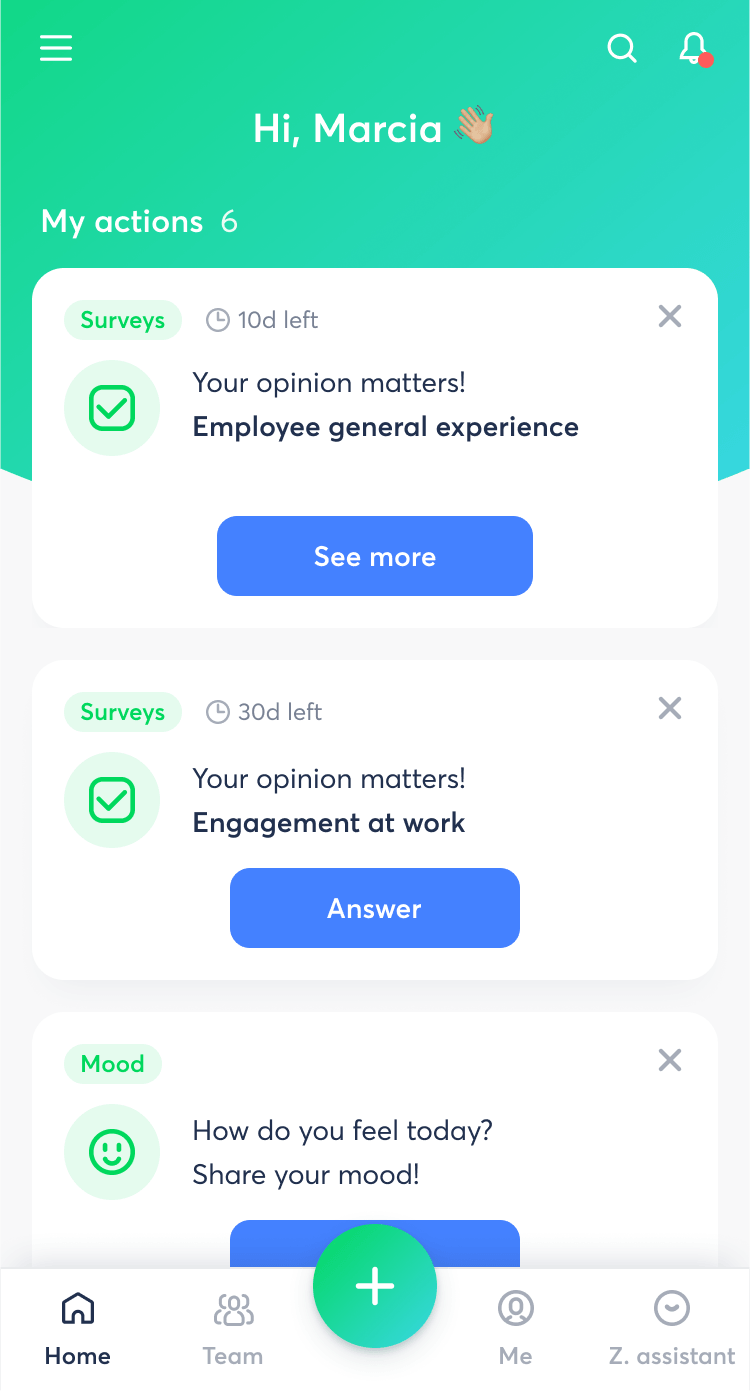
Zest reaches every employee through mobile, QR code, and conversational mode, including those without a dedicated computer workstation.
The strength of the Pulse survey lies in the precision of its targeting. A post reorganization survey doesn’t concern the whole company. An onboarding follow up is aimed at a specific cohort, at a specific moment. Dynamic segments synchronized with your HRIS (ADP, Talentsoft, SAP SuccessFactors) ensure that every employee receives the right survey at the right time, with no manual intervention between campaigns.
Read the signal before it becomes a problem
With a Pulse, the value isn’t in the report. It’s in the speed of detection.
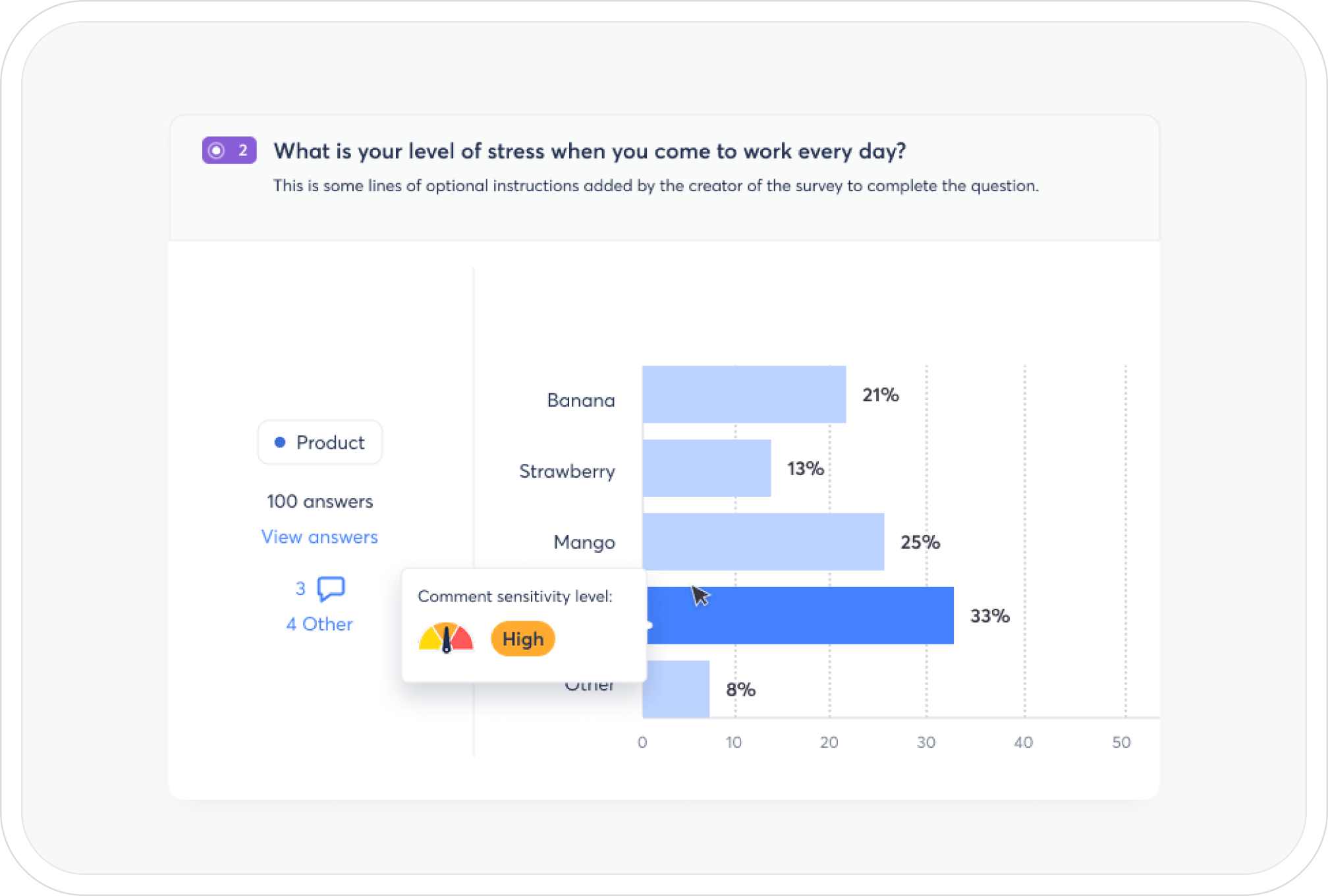
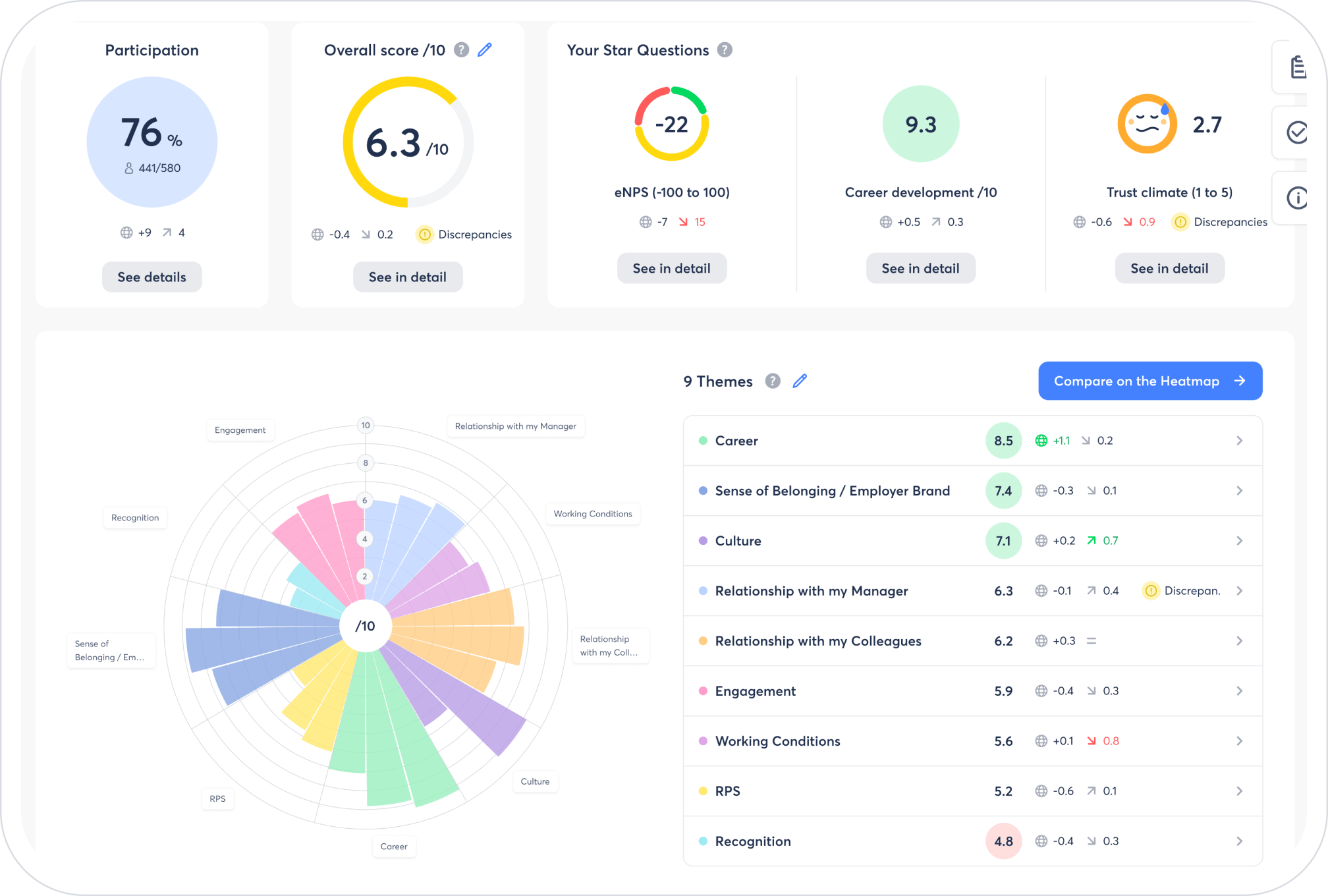
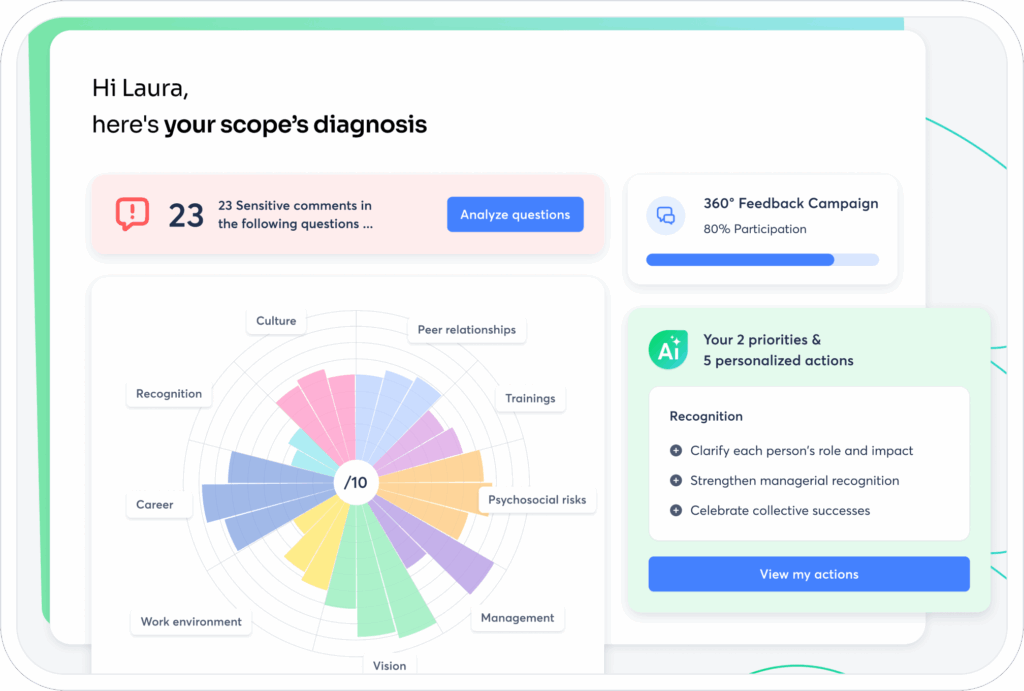
Scores arrive in real time, by team. AI flags signals that fall outside the norm: a team losing momentum, a sensitive comment, an area deteriorating between two campaigns. The manager concerned is alerted directly, without waiting for an HR debrief.
The consolidated view lets HR track trends across the organization, compare dynamics between sites or populations, and prioritize actions with full visibility.
Employee listening doesn’t stop at the score
The Pulse only has value if the employee sees a follow up. That’s what sets a listening culture apart from a survey culture.
From every result, the manager generates an action plan directly in Zest, with recommendations tailored to their scope. Progress is tracked over time and visible to HR across the organization. By the next campaign, the impact of the actions taken can be measured in the scores.
When should you launch a Pulse survey?
The Pulse is useful anywhere the situation changes faster than the barometer can measure.
 Post reorganization or merger

The first few months are decisive. A monthly Pulse tracks how the sense of belonging stabilizes and identifies teams losing momentum before departures start piling up.
 During periods of economic pressure

When teams are going through a slowdown or restructuring, regular listening is the first sign that leadership grasps the situation. It also reduces uncertainty, which is often more damaging than the reality itself.
 Onboarding follow up

An employee rarely disengages during their first month. The signals appear at day 30, 60, 90. A Pulse structured around these milestones makes it possible to act before the decision to leave is made.
Post barometer

Launching a Pulse two to three months after the barometer results are shared shows whether the action plans were noticed and understood. It’s also the best way to show employees that their voice made a difference.
On the ground management

In production, logistics, or personal service environments, an ultra short weekly Pulse (3 questions, weather style format) gives frontline managers a read on team morale without adding to the daily workload.
How can you get the most out of your Pulse survey?
The real value of the Pulse survey comes from connecting it to the rest of your organization’s data.
- Pulse and barometer. The Pulse tracks change between two structured campaigns. The employee engagement barometer confirms or nuances what the Pulse detected. The two reinforce each other.
- Pulse and 1:1s. Pulse results feed directly into the manager employee 1:1. The manager comes in with data, not impressions.
- Pulse and absenteeism. Zest connects engagement data with absenteeism indicators. At risk teams are identified 3 to 6 months before absenteeism becomes entrenched. According to Gallup, organizations that actively manage engagement see 41% less absenteeism.
What sets Zest apart from a generic survey tool?
Accessible to 100% of your teams, including the field
Mobile, QR code, offline mode, conversational interface: no employee is excluded for lack of a computer.
Field deployments see participation rates 10 to 15 points higher than desktop tools. A Pulse that doesn’t reach the field doesn’t measure much at all.
Built for the manager, not the report
With a Pulse, the value isn’t in the report. It’s in the speed of detection.
Scores go in real time directly to the managers concerned, along with AI powered recommendations for action.
Expert support included
Every client is supported by a Customer Success Manager specialized in HR: choosing the right trigger moments, configuring campaigns, analyzing results, and providing actionable recommendations.
Calculate the ROI of your employee listening program
According to Gallup, organizations that actively manage engagement see 59% less turnover, 41% less absenteeism, and 23% additional profitability.
The lost revenue tied to unanticipated departures and unaddressed absenteeism can be calculated. Zest gives you the method to calculate it and present it to your leadership as a business case.
Q&A
Frequently asked questions about Zest’s Pulse survey software
Can we combine Pulse and the employee engagement barometer within Zest?
Yes. Both coexist within a single interface. The data complement each other: the employee engagement barometer provides the annual diagnosis, while the Pulse tracks what changes between two campaigns. Dashboards automatically consolidate both sources.
How often does Zest recommend launching a Pulse?
It depends on the context. A monthly Pulse works well for ongoing engagement tracking. A weekly Pulse suits fast moving field environments. A one off Pulse is relevant after a major event. Your Customer Success Manager helps you define the right pace for your organization.
Won’t employees get tired of it?
Survey fatigue isn’t linked to frequency. It’s linked to the absence of follow up. Based on Zest’s client base, organizations that communicate about the actions taken maintain a stable, or even growing, participation rate from one campaign to the next.
Is Zest’s Pulse accessible to field teams without a computer?
Yes. Mobile, QR code, conversational mode, and shared terminals cover every field configuration. No population is excluded from the measurement.
Does Zest offer ready to use Pulse templates?
Zest has native connectors with the leading HRIS platforms on the market (ADP, Talentsoft, SAP Success Factors, and others). Employee data is synchronized automatically, with no manual re entry and no involvement from the IT department.
What is the difference between Zest and a generic survey tool?
Zest’s questionnaires are designed with psychometricians and occupational psychologists: each question measures a specific, scientifically validated driver of engagement. Results go directly to the managers concerned, with recommendations for action, not just another report to sift through. And barometer data feeds directly into 1:1s, objectives, and the People Review. A generic survey tool stops at the score. Zest starts where others stop.

Allow all cookies
Continue without accepting

Zest respects your privacy
Zest and its partners use cookies or similar technologies and process personal data which may be cross-referenced with information provided as part of our services for the following purposes: to improve your user experience, to carry out audience statistics and studies to improve our offers, to provide you with services tailored to your interests, to display targeted advertising on our site or those of our partners, and to measure the performance of such advertising. Some cookies are necessary for the operation of the site and our services. You can accept, manage your preferences by purpose or continue browsing without accepting.
Cookie settings
Allow all cookies
