Motivation: at the heart of your employee engagement strategy
Au programme :
Le récap de l’article
Let’s discover together in this article the importance of motivation at the heart of employee engagement.
People don’t buy what you do, they buy why you do it
Simon Sinek
The two facets of motivation
When discussing motivation, it’s important to consider the two principal driving forces:- Intrinsic motivation refers to our internal drive to do something, perhaps because we find it interesting and/or enjoy doing it. This could be a desire for learning, innovating or collaborating with others.
- Extrinsic motivation on the other hand are those external forces (i.e. incentives) that motivate us. These could be positive, such as feedback, pay-rises & benefits, or an aversion to negative consequences, such as wanting to avoid an angry manager.
Understanding the link between motivation and engagement
Tapping into employees’ internal motivation is therefore key to reaping the benefits that motivation in the workplace can bring. To do so, understanding the link between employee motivation and employee engagement is a crucial first step.What is engagement?
In a workplace context, engagement refers to “a positive emotional state that yields a feeling of energy and leads to positive work-oriented behaviours” ². Essentially, engagement can be seen as the middle-man, a “state”, lying between specific motivational factors (what’s driving us) and our desired behaviour. Assessing the level of employee engagement is an essential baseline measure, enabling organisations to gauge how employees are feeling with regards to their work and the company. Of course alone, this information is insufficient. A simple “engagement score” is useful and necessary to have, but understanding precisely why employees are engaged or disengaged, what aspects of their working life are they satisfied or dissatisfied with, is essential to taking action. This is what Zest’s survey tool offers.Understanding what motivates your employees
Communication is key. To discover what really motivates your employees at work, ask them! Find out what the most important motivators are for your employees and notably, how they rate the organisation on this topic. Our Key Drivers feature (part of Zest’s Listen pillar) makes it easy to identify what drives employees and see the highest and lowest scores for the company. Remember that motivators will differ between individuals and will undoubtedly change over time.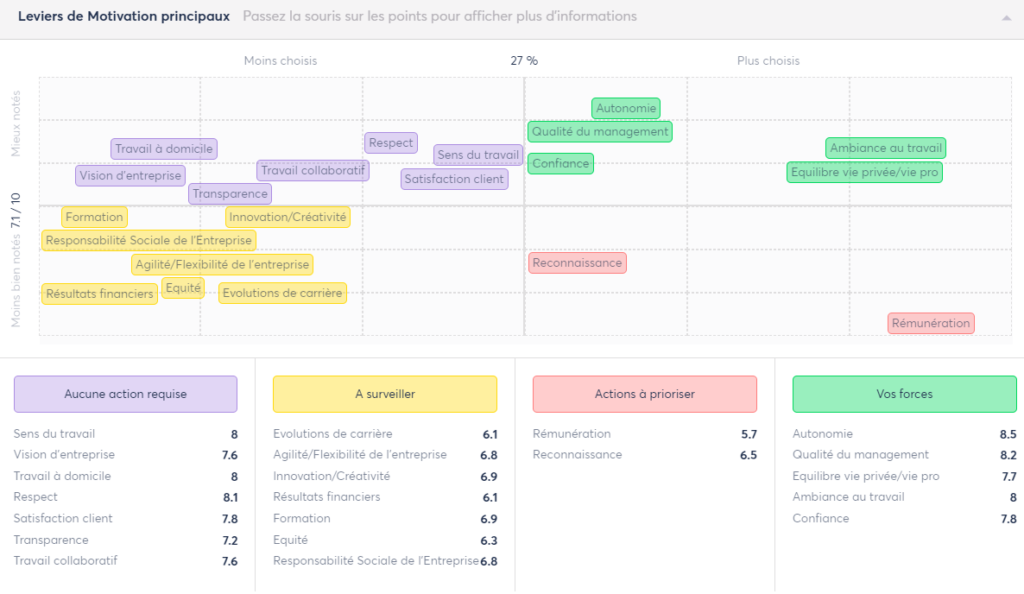
4 key ways to enhance motivation
As we saw earlier, tapping into what drives employees internally is key to enhancing motivation and engagement. Let’s take a look at some examples of ways to enhance intrinsic motivation in the workplace ³.Autonomy
People have a basic psychological need to feel that they have control over their own behaviour, although this doesn’t necessarily have to mean that they must be independent of others ⁴. Providing employees with ownership over their own work can help to demonstrate trust in the employee-employer relationship and can be hugely rewarding to the employee. This need is close to the need for psychological safety mentioned in a previous article. Purpose Setting SMART goals is a well-established way to enhance workplace motivation and performance ⁵. Setting objectives using methods such as the OKR method can help to provide individuals with a sense of achievement and self-efficacy at work.The alignment of these objectives can also help individuals to see how their work contributes to the wider goals of the organisation, thus providing meaning and purpose. Zest proposes an intuitive and simple solution to put in place the OKR method.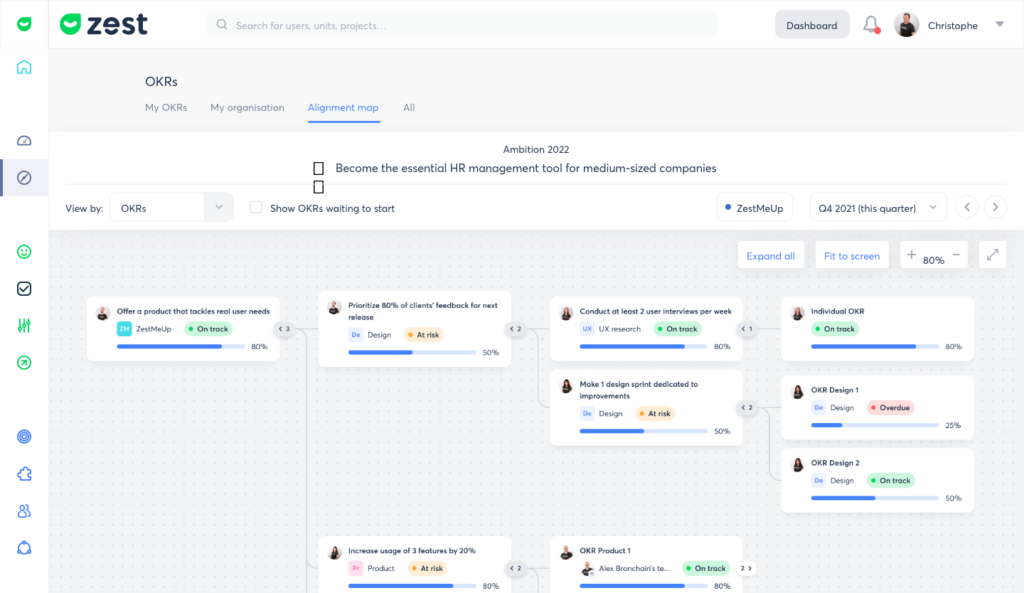
Mastery
Another basic psychological need ⁴ is an individual’s need to improve our skill level. Offering employees with continuous opportunities to enhance their existing skills or learn new ones is an important way to motivate someone who has a drive to learn. But it is also important to mention one form of extrinsic motivation, which is critical to individual performance.Recognition
Recognition and praise for employee efforts, be it public or private, demonstrates to the employee that you are just as engaged with them as they are with you. Research shows that even just the simple act of acknowledging individual efforts has a profound impact on motivation ⁶. Zest proposes a fun and collaborative feedback solution as part of the web and mobile app.Take-home messages
- Motivation is at the heart of employee engagement: understanding both intrinsic and extrinsic sources of motivation is an essential part of an organisation’s employee engagement strategy.
- Managers must take an individualised approach when uncovering what motivates employees. What’s important for some may not be so important for others and this will likely change over time.
- Leaders should take into account these 4 key sources of motivation in their attempts to enhance employee engagement: autonomy, purpose, mastery & recognition.