Psychological safety: the key to boosting the performance of your teams and your business
Summary of the article
What does psychological safety look like in companies? What are its indicators and benefits? And how can a digital solution such as Zest enable your company to create a climate of psychological safety?
What is psychological safety?
Psychological safety refers to a professional environment where:
- Employees can express their ideas and opinions freely, without fear of being judged or suffering negative consequences.
- Employees can take risks.
- Employees can raise difficult issues and questions.
- Each person’s unique talents and skills are valued.
- Employees are not blamed or punished for their mistakes (blameless postmortem, Google 2).
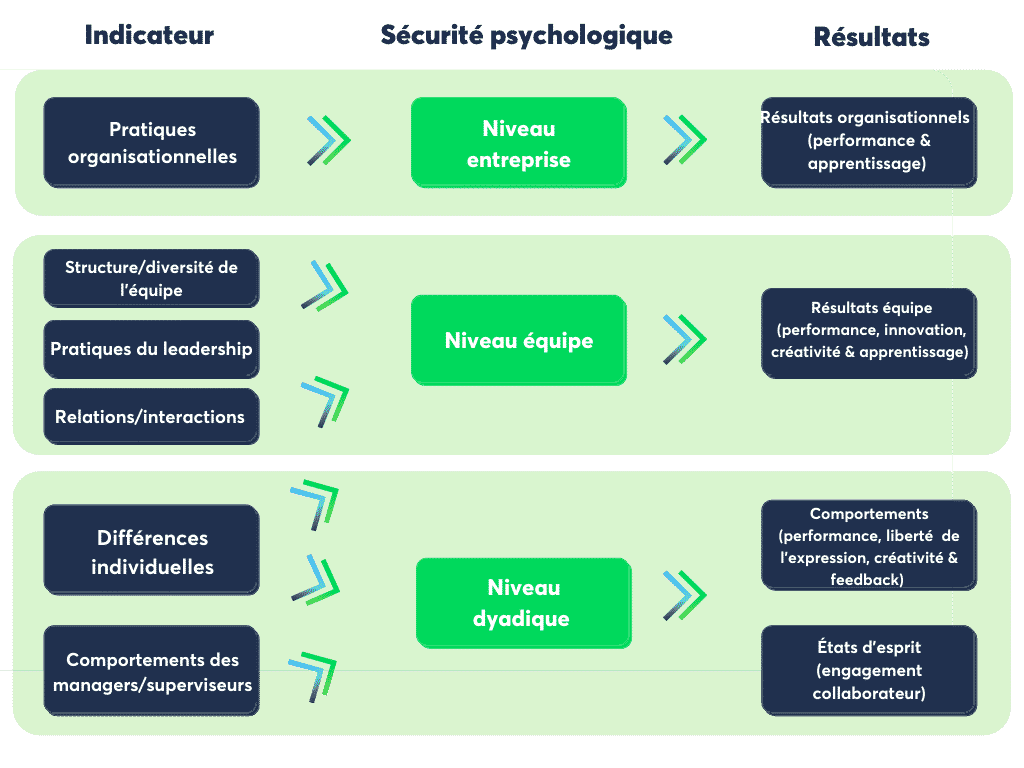
We can consider that a climate of psychological safety exists at several levels: at the company level, at the team level, or within dyadic relationships (for example, between an employee and their manager, see Figure 1). To measure this concept, Amy Edmondson’s (1999 1) seven-question survey is by far the most widely used tool for assessing the climate within a team. For example:
Please indicate to what extent you agree or disagree with this statement: « If I make a mistake within my team, they criticise me for it. »
To measure psychological safety at the company level, we can replace the word ‘team’ with ‘company’ in the above sentence. Finally, we can assess individuals’ perceptions of their own psychological safety in dyadic relationships (e.g. between an employee and their manager). For example:
Please indicate to what extent you agree or disagree with this statement: « If I make a mistake, my manager criticises me for it. »
Figure 1.
What are the benefits of psychological safety in the workplace?
Scientific literature shows that psychological safety has many positive impacts:
🟢 Performance : The Aristotle project carried out by Google² identified psychological safety as the distinguishing feature of the most effective teams. The results showed that the way the team functions as a whole is more important than the individuals who make it up. For example, do individuals feel comfortable enough to take risks?
🟢 Learning: observed at both individual and team level (3), a culture of psychological safety allows individuals to learn from their mistakes rather than being blamed for them.
🟢 Creativity and innovation: psychological safety is positively correlated with innovation and R&D (4), particularly at the team level.
🟢 Continuous and upward feedback: giving honest feedback to supervisors and informing them of mistakes made5.
🟢 Freedom of expression: challenging the actions or decisions of supervisors 6.
🟢 Open communication: sharing knowledge and reporting errors within the team7.
🟢 Employee engagement: the more employees feel psychologically secure, the more committed they are to their work.8 9.
For all results relating to the different levels, see the study by Newman et al., (2017) 7.
An update on diversity and inclusion (D&I)
Psychological safety is just as essential to the success of diversity and inclusion initiatives. By definition, a climate of psychological safety is one in which employees can express themselves freely, without fear of negative consequences, and where they are accepted for who they are. Studies show that it is essential to establish a climate of psychological safety in order to leverage the diversity of a workforce (particularly to optimise performance). In this way, we can consider psychological safety as a mediator in the relationship between diversity and employee performance (10).
 What metrics can be used to measure psychological safety?

To fully understand how to improve psychological safety and boost employee engagement and performance, we must first understand its indicators (see Figure 1). We can consider that the indicators relate to different levels.
In regard to the organization, studies show that:
- The support offered by the company (such as support for people returning to work after a long absence or the introduction of a mentor),
- Company policies on diversity (10) and, in particular, how individuals, especially those from minority groups, perceive these organisational efforts,
… influence the level of psychological safety within the company (7). With its Mood feature, engagement meter and trust climate survey model, Zest allows you to better understand your employee experience and implement actions aligned with your teams’ needs.
At the team level:
- The structure and organisation of the team (the more clearly defined the division of tasks, the role of leaders within the team, priorities, daily tasks and procedures are, the more employees feel psychologically secure),
- Relationships between team members (can team members trust each other? (8)
- Leadership practices such as inclusivity of leaders (6) (do managers listen to the team’s ideas?) and shared leadership (3) (sharing responsibilities or tasks among team members),
…enable the creation of a climate of psychological safety felt by teams.
At the dyadic level:
- The behaviour of managers/supervisors, particularly their integrity (consistency between what a person says and what they do)
… also influence the sense of psychological security11.
Of course, individual differences inevitably play an important role, particularly self-awareness, which is negatively correlated with perceived psychological safety. 8.

What situations can cause anxiety in the workplace?
- Work overload: working in a constantly high-pressure environment causes anxiety. Consider setting reasonable deadlines and workloads.
- Excessive control of teams: micromanagement makes employees feel monitored and undervalued. Trusting your team is essential for maintaining healthy relationships.
- Harassment and discrimination: the workplace must be a place where employees feel psychologically and physically safe.
-
Job insecurity: precarious contracts prevent employees from planning for their future within the organisation and feeling valued.
-
A toxic organisational culture: a negative culture that lacks trust and shows little recognition can cause stress and possibly burnout among employees.
-
Poor communication: employees should be supported through change rather than forced to endure it. Communicating about the stages and changes inherent in the business is essential.
How can we create a climate of psychological safety?
💫 Foster a sense of belonging:
Feeling aligned with the company’s values and being able to demonstrate their impact on the company’s development allows employees to feel grounded and move forward with confidence.
💫 Favoriser l’apprentissage:
Chacun a besoin d’évoluer et apprendre de nouvelles compétences permet à chaque collaborateur de rester stimulé et enthousiaste.
💫 Promoting learning:
Teamwork is a source of energy, it promotes bonds between colleagues and allows everyone to get involved in the collective.
💫 Encourage critical thinking:
Questioning oneself promotes progress and improvement and allows one to remain in a dynamic state of evolution.
💫 Building a culture of failure:
Projects that have not been successful provide opportunities to learn and develop practices.
The role of each individual in creating a climate of psychological safety
👤 Leaders and managers
Leaders and managers have two essential roles. They serve as role models and provide support to employees. Their behaviour has a direct impact on the working environment. Encouraging open communication, treating employees with respect and ensuring a caring working environment are necessary for teams to enjoy good psychological health.
👤 Staff members
Employees are essential links in the team. They can support and listen to each other and nurture the company’s caring culture by providing feedback and sharing their concerns.
👤 Human resources professionals
Human resources professionals monitor and resolve conflicts, can implement a reporting policy to protect employees, and also offer training and awareness-raising sessions on psychological safety in the workplace.
What tools can be used to regularly monitor the psychological safety climate?
In practical terms, how can you create a climate of psychological safety within your company? Here are a few suggestions with Zest:
- First, monitor the level of psychological safety in your company using the module: Listen > Surveys.
- Check in with your employees regularly: with the Listen module, you can allow your employees (both staff and managers) to indicate how they are feeling each day (anonymously or publicly). And don’t hesitate to do a quick round-table discussion before starting a meeting to find out what concerns your employees have.
- Give your employees a voice: with the Share > Ideas module, you can create a space where employees can share their ideas with the team and management. Respond to these ideas or comment on them to show that you are listening to your employees (and above all, make sure that these ideas are followed up with action!). Asking employees to share their ideas, thoughts and opinions is one of the main ways to create a culture of psychological safety.
- Encourage a culture of feedback: continuous, informal and, above all, bottom-up feedback encourages employees to share their opinions about management with confidence. With a simple and easily accessible tool, everyone can receive and give feedback anytime, anywhere, using Zest.
Conclusion
To gain a competitive advantage in their industry, companies must encourage their employees to share their new and innovative ideas. Although this concept is new, studies show that a climate of psychological safety is key. Zest offers a simple and effective solution to help your company develop this climate and, as a result, boost the engagement, performance, creativity (among other things) of your teams and your company!
Références
1 Edmondson, A. (1999). Psychological safety and learning behavior in work teams. Administrative science quarterly, 44(2), 350-383
2 Google (2012). Project Aristotle. https://rework.withgoogle.com/print/guides/5721312655835136/
3 Liu, S., Hu, J., Li, Y., Wang, Z., & Lin, X. (2014). Examining the cross-level relationship between shared leadership and learning in teams: Evidence from China. The leadership quarterly, 25(2), 282-295.
4 Carmeli, A., Reiter-Palmon, R., & Ziv, E. (2010). Inclusive leadership and employee involvement in creative tasks in the workplace: The mediating role of psychological safety. Creativity Research Journal, 22(3), 250-260.
5 Wilkens, R., & London, M. (2006). Relationships between climate, process, and performance in continuous quality improvement groups. Journal of Vocational Behavior, 69(3), 510-523.
6 Bienefeld, N., & Grote, G. (2014). Speaking up in ad hoc multiteam systems: Individual-level effects of psychological safety, status, and leadership within and across teams. European journal of work and organizational psychology, 23(6), 930-945.
7 Newman, A., Donohue, R., & Eva, N. (2017). Psychological safety: A systematic review of the literature. Human Resource Management Review, 27(3), 521-535.
8 May, D. R., Gilson, R. L., & Harter, L. M. (2004). The psychological conditions of meaningfulness, safety and availability and the engagement of the human spirit at work. Journal of occupational and organizational psychology, 77(1), 11-37.
9 Chen, C., Liao, J., & Wen, P. (2014). Why does formal mentoring matter? The mediating role of psychological safety and the moderating role of power distance orientation in the Chinese context. The International Journal of Human Resource Management, 25(8), 1112-1130.
10 Singh, B., Winkel, D. E., & Selvarajan, T. T. (2013). Managing diversity at work: Does psychological safety hold the key to racial differences in employee performance?. Journal of Occupational and Organizational Psychology, 86(2), 242-263.
11 Palanski, M. E., & Vogelgesang, G. R. (2011). Virtuous creativity: The effects of leader behavioural integrity on follower creative thinking and risk taking. Canadian Journal of Administrative Sciences/Revue Canadienne des Sciences de l’Administration, 28(3), 259-269.