The annual review is the most common evaluation model used in organizations. But is it still relevant to set objectives at the start of the year and assess individual performance only at the end? The question is worth asking.
What if the quarterly review could modernize the annual review? A closer look, with Zest software, at this disruptive, agile, and strategic management ritual.
Quarterly review: what exactly are we talking about?
What does a quarterly review involve?
It’s an evaluation ritual that enriches the annual review and makes it more effective, by increasing the number of dedicated manager-employee touchpoints throughout the year.
With the Zest tool, modernize your HR rituals in a simple and intuitive way.
Is the quarterly review mandatory?
No, but it’s strongly recommended given its individual and collective benefits. It addresses employees’ need for meaning, empowerment, and continuous development, boosting their motivation as a result.
It also strengthens teams’ trust in their manager, giving the manager greater visibility into potential friction points. The end result: stronger engagement and performance across the company.
Annual review vs. quarterly review: what’s the difference?
The annual review
The annual review marks the close of the year. It takes stock of work and performance (objectives achieved, strengths, areas for improvement), gauges how employees feel, and sets the roadmap for the year ahead.
The quarterly review
The quarterly review, on the other hand, feeds into the annual review. It follows an agile approach centered on developmental evaluation, with 3 interim reviews and 1 final review. This empowering management strategy, built on co-construction and regular active listening, boosts employee engagement and provides ongoing support.
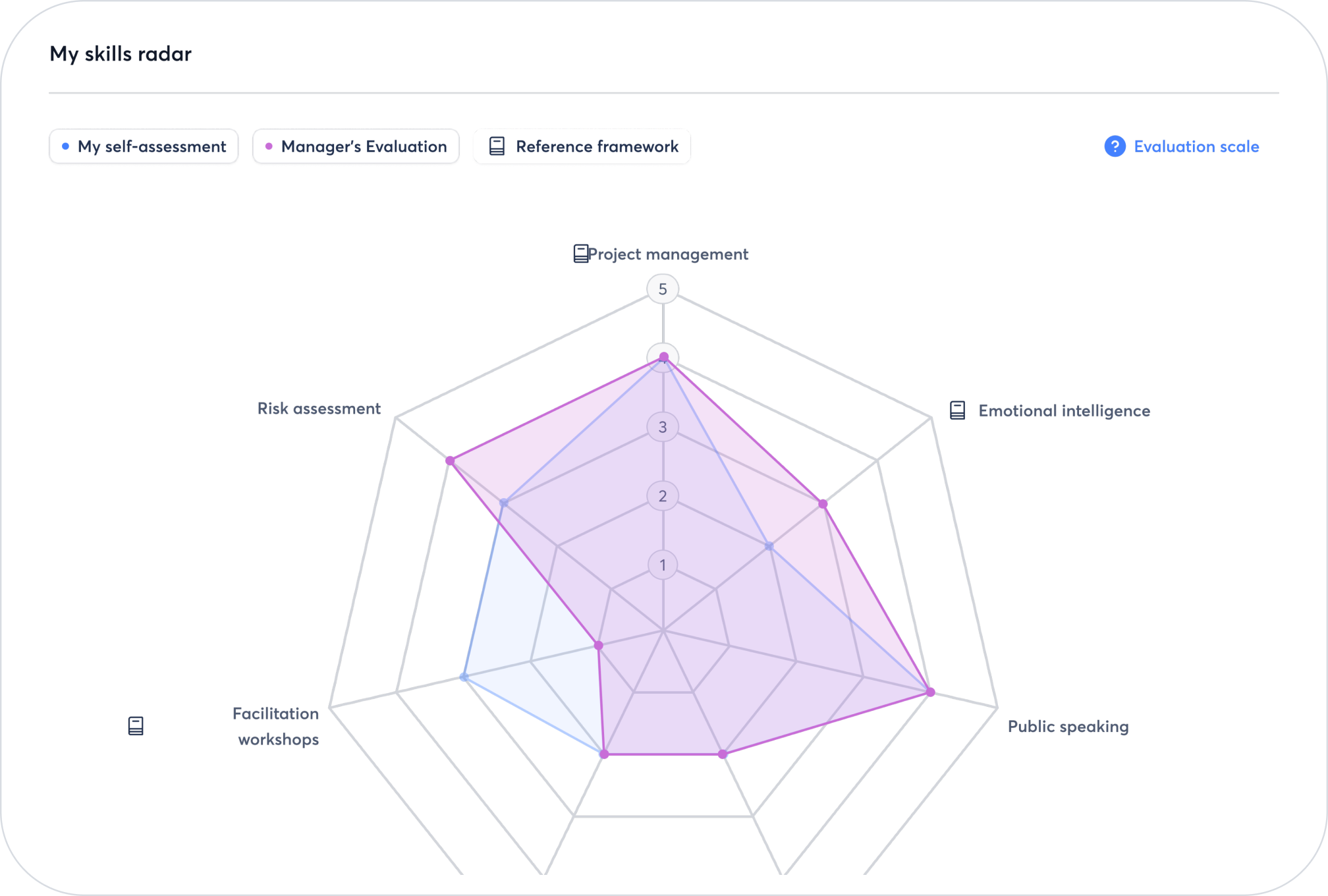
Parmi les points évoqués :
Tracking of quarterly objectives
Check-in on needed resources
How employees are feeling
Recognition of interim wins
Zest disrupts your reviews, for better performance!
Why introduce quarterly reviews?
✅ Encourage dialogue and feedback
Quarterly reviews are regular management touchpoints, with genuine conversations about the issues that matter most, or that are holding an employee back. They’re an opportunity to give and receive feedback continuously, without pressure.
The Zest advantage: Zest is designed to encourage collaboration and recurring feedback.
✅ Check in regularly on objectives and working methods
The quarterly review also breaks up the year with interim check-ins on working methods and set objectives. Do they still make sense? Are they clear? How should they be adjusted?
The Zest advantage: Objective or OKR management can be decoupled from the formal review, for ongoing management throughout the year.
✅ Strengthen the relationship between managers and teams
Quarterly check-ins are also the ideal way to build closeness and reciprocity between managers and teams, by fostering constructive conversations, a culture of continuous feedback, and active listening.
The Zest advantage: Zest’s flexibility lets you launch reviews to match your needs, whether quarterly, twice a year, or even monthly.
✅ Identify and resolve friction points early
Quarterly reviews help prevent and manage potential friction points more effectively, catching them before the annual evaluation. A key issue worth taking seriously.
The Zest advantage: The option to invite contributors other than the manager, enriching the discussion and making it more objective.
✅ Strengthen talent retention
Finally, the quarterly review gives employees a chance to showcase their work and skills, request training, grow, get involved in their own development and that of the company, and help shape their next objectives, all key levers for retaining talent.
The Zest advantage: Beyond managing reviews, Zest supports employees in their professional development.
How a quarterly review unfolds
It generally takes place in 5 steps.
Preparation on the employee’s side
The employee reflects on various aspects of their day-to-day work: achievements over the quarter, how they’re feeling, and feedback on the team, the manager, and the company.
La préparation côté manager
Le manager, lui, prépare des feedbacks constructifs, mettant en avant les axes d’amélioration et succès du collaborateur. Pensez au feedback 360° ! Il offre une représentation complète de la performance via une multiplicité de points de vue.
Preparation on the manager’s side
The manager, in turn, prepares constructive feedback, highlighting the employee’s areas for improvement and successes. This is a great time to use 360° feedback! It provides a complete picture of performance through multiple points of view.
Tracking objectives and the dashboard
It’s important to put management rituals in place with clear performance objectives and indicators, aligned with the overall strategy.
Writing up the summary
The quarterly review is documented in a written summary covering the points discussed, signed by the employee, who keeps a copy.
Setting up post-review actions
Finally, the manager considers the employee’s areas for growth (soft skills, hard skills). The goal is to agree on an action plan and objectives to achieve over the next 3 months.
Make your quarterly reviews easier with Zest digital suite
The Zest tool is intuitive and effective, modernizing the annual review by enabling agile dialogue, regular feedback, and quality listening. In Zest, reviews take place in 3 stages.
1
Employee preparation
Answering the review framework’s questions: overall feelings, tracking of objectives, need for help/support/coaching, outlook, and QWL (quality of work life).
2
Manager preparation
Reviewing the employee’s answers, then submitting their own responses (summary phase).
3
Validation step (optional)
The employee reviews the manager’s comments and validates the review.
« I used to put off formalizing my teams’ annual reviews because I didn’t have the time and the process was too cumbersome. Zest has ‘changed my life’ when it comes to that! »
– David RODRIGUES, Human Resources and Recruitment Business Partner, Celio
Zest and its partners use cookies or similar technologies and process personal data which may be cross-referenced with information provided as part of our services for the following purposes: to improve your user experience, to carry out audience statistics and studies to improve our offers, to provide you with services tailored to your interests, to display targeted advertising on our site or those of our partners, and to measure the performance of such advertising. Some cookies are necessary for the operation of the site and our services. You can accept, manage your preferences by purpose or continue browsing without accepting.



 Tracking of quarterly objectives
 Check-in on needed resources
 How employees are feeling