Employee Turnover: Definition, Costs and How to Reduce It

At a glance
Turnover measures how a company’s workforce renews over time. Learn how to calculate it (INSEE and operational methods), the average rate in France (15%), its main causes, its direct and hidden costs, and the key levers to reduce it: onboarding, hands-on management and listening to your employees.
Employee turnover: definition, costs and areas for improvement
Employee turnover measures how much your workforce changes over a given period, usually a calendar year. It covers departures, including resignations, dismissals and contracts coming to an end, as well as new hires joining the company. A controlled level of turnover is a normal part of organizational life. High turnover, however, has a lasting impact on performance, team cohesion and the company’s finances.
Identifying its causes, knowing how to calculate your turnover rate and understanding its true cost are the first steps toward taking effective action.
What is employee turnover? Definition and HR challenges
Employee turnover refers to the rate at which an organization’s workforce is renewed over a given period. The higher the rate, the more frequent the staff movements. The lower the rate, the more stable the teams over time.
This figure is never neutral. It reflects how attractive your company is, the quality of its management, the working atmosphere and, ultimately, the overall health of your organization. Tracking it regularly helps you anticipate HR issues before they become critical.
The term comes from the verb “to turn over”, meaning to renew or replace. Depending on the source, you will also see it called staff turnover, labor turnover or employee turnover rate. All of these describe exactly the same reality: the number of employees joining and leaving your company over a given period. The choice of term mostly depends on context: “turnover” in a leadership meeting, “labor turnover” in official HR reporting.
Voluntary vs involuntary turnover, internal vs external turnover
Not every departure tells the same story, and this distinction completely changes the diagnosis.
Voluntary turnover: the employee chooses to leave, through a resignation, a mutual termination agreement they initiated, or early retirement. A high rate here should raise a red flag. It often points to a retention problem or a deteriorating social climate.
Involuntary turnover: the company decides on the departure, through a redundancy, a dismissal for misconduct, or the employer ending a probationary period. This tends to signal a recruitment problem or a poor match between candidate and role.
Internal turnover: an employee changes role or department within the company, with no actual departure from the workforce.
External turnover: the employee leaves permanently to pursue their career elsewhere.
Confusing these categories, or being unable to tell them apart, means missing the right diagnosis. A company with 20% turnover driven mainly by retirements faces a very different problem from one with 20% turnover driven by senior managers resigning.
How do you calculate the turnover rate?
The turnover rate formula is simple. The real challenge lies in knowing which departures to include and which method to use. There are two approaches.
The turnover rate formula: INSEE method vs operational method
The INSEE method is the benchmark used by INSEE (France’s national statistics institute) and DARES (the French Ministry of Labor’s research department) in their publications on workforce movements. It measures the overall intensity of inflows and outflows over the period, and is calculated as follows:
Turnover rate = [(number of hires + number of departures) ÷ 2] ÷ average headcount × 100
Average headcount is calculated as: (headcount on January 1 + headcount on December 31) ÷ 2. Use this formula if you want to compare your rate with national or industry averages.
The operational method is more down to earth. It focuses solely on departures and speaks more directly to managers looking to drive retention day to day:
Turnover rate = (number of departures ÷ average headcount) × 100
Be careful: a fast-growing company that is hiring heavily will show a high INSEE turnover rate without actually losing employees. In this case, the operational method gives a more accurate picture.
Step-by-step turnover rate calculation example
Take a company with 100 employees on January 1 and 110 employees on December 31. Over the year, it made 22 hires and recorded 12 departures.
- Average headcount: (100 + 110) ÷ 2 = 105 employees
- INSEE method: [(22 + 12) ÷ 2] ÷ 105 × 100 = 16.2%
- Operational method: (12 ÷ 105) × 100 = 11.4%
Two different results for the same reality. Always state which method you used when sharing a turnover rate. Otherwise, no meaningful comparison is possible.
What is the average turnover rate in France?
According to INSEE, the average turnover rate in France is around 15% per year. This figure hides wide variations depending on industry and company size.
What turnover rate is considered acceptable?
| Turnover rate | What it means |
|---|---|
| Below 5% | Stagnation zone. Nobody leaves, but nobody joins either, a possible sign of a company that struggles to attract talent. |
| 5% to 10% Ideal | Healthy zone. The workforce renews itself without destabilising the organisation. |
| 10% to 15% | French average. Nothing alarming, but regular monitoring is still needed. |
| Above 15% | Warning zone. Turnover calls for an action plan. |
| Above 25% | Critical situation. Constant hiring, loss of collective knowledge, exhaustion among remaining teams. |
These thresholds should always be read in light of your industry. A 28% rate is within the norm for the restaurant sector. The same figure in banking should trigger an immediate alert.
What causes employee turnover?
High turnover never comes out of nowhere. Behind every wave of departures, the same causes tend to appear, either on their own or in combination.
- Poor management: micromanagement, lack of feedback, perceived unfairness in promotions. As the saying goes, people don’t leave companies, they leave managers.
- Lack of career development opportunities: several international HR studies rank this as the leading cause of resignations, well ahead of pay.
- Deteriorating working conditions: excessively long hours, mental load, poor work-life balance.
- Uncompetitive pay: rarely a factor on its own, but one that makes things worse when combined with the issues above.
- Failed onboarding: a rushed integration leads a significant share of new hires to consider leaving within their first six months.
How can you spot early warning signs before an employee resigns?
Taken individually, some signs don’t mean much. Combined, they deserve your attention:
- Lower engagement or participation in meetings and team activities
- An increase in occasional absences, late arrivals or short sick leaves
- A voluntary reduction in involvement on projects
- Unusual silence during one-to-one meetings, or evasive answers
- An updated LinkedIn profile or increased networking activity
- Fewer requests for training or internal mobility
That is why it is essential to take the pulse of your employees on a regular basis. One effective way is to schedule a social climate barometer at regular intervals. Try our free questionnaire generator to measure your social climate and anticipate turnover.
How much does turnover cost your company?
A departure always costs more than you think, and most of the bill rarely shows up on standard financial dashboards. Read our dedicated article on the cost of employee turnover.
Direct and hidden costs of turnover
Direct costs Visible
- Recruitment costs: job ads, agency fees, HR time
- Training and onboarding of the new hire
- Severance pay and final settlement
- HR and management time spent on the process
Hidden costs Often underestimated
- Lost productivity while the replacement gets up to speed
- Lower morale in teams absorbing the extra workload
- Loss of expertise and organisational knowledge
- Deteriorating workplace climate and team cohesion
- Risk of losing clients loyal to the departing employee
These hidden costs do not appear on any accounting line, yet they weigh heavily on results. In the most exposed industries, high and poorly managed turnover can cost several percentage points of revenue.
How can you reduce employee turnover?
✅ Analysis
The first step in reducing turnover is recognizing that it exists and, most importantly, pinpointing its exact causes. Analysis plays a fundamental role here. Solutions such as Zest’s make this easier by providing a real-time view of your social climate.
✅ Employee listening
With its anonymous approach and engaging format, the Zest tool helps management and leadership connect with employees and show them that their opinions matter. Acting as a true engagement barometer, it reveals the specific reasons behind drops in motivation and encourages proactive action to restore employee well-being.
✅ Relevance
Once trust has been restored, you can start putting concrete measures in place to tackle turnover. It is essential to show employees that there is a genuine commitment to change, and that this change will be driven by their feedback. However, to avoid undermining the efforts already made, new decisions should be aligned with employee expectations, and people should be placed on the right assignments. Where needed, a tailored training path can be offered.
✅ Long-term communication
By conducting audits at regular intervals and keeping track of how team aspirations evolve, management can gradually build a work environment where everyone can thrive. Constant dialogue between leadership and frontline teams may seem time-consuming, but it helps employees feel respected and valued. Bear in mind, though, that aiming for zero turnover would be counterproductive. Bringing turnover down to an ideal level does not mean eliminating it entirely. When well managed, it brings in fresh energy and new ideas, along with the new skills a company needs to stay sustainable.
Ultimately, there is no silver bullet for reducing turnover. It takes a combination of levers, activated at the right time and applied consistently:
- Take care of onboarding from day one: a ready workstation, a clear path and a designated point of contact. The first 90 days often determine whether a new hire stays for one year or five.
- Build hands-on, close management: fifteen minutes of genuine conversation with each team member every week matters more than a marathon monthly meeting.
- Create clear career development opportunities: internal mobility, continuous training and a formal career plan, even in small organizations.
- Streamline how work is organized: planned schedules, simple leave management, and everyday frustrations dealt with as a priority.
- Give continuous feedback: an annual review is no longer enough. Regular check-ins and adjustable objectives make all the difference.
- Measure your social climate regularly: track turnover by department, average length of service and eNPS, rather than suffering departures without seeing them coming.
A structured measurement tool such as Zest’s employee engagement software is a game changer. It turns team sentiment into objective data, flags early warning signs before they turn into resignations, and helps you focus your HR actions on the issues that really matter.
Request a demoTake action now: generate your free social climate barometer questionnaire and give your teams a voice before they leave.
Anticipate turnover with a free employee survey
According to BaromEX by Zest 2024, 23% of French employees are considering leaving their company within the next 12 months. To spot these intentions before they turn into resignations, nothing beats listening directly to your teams. Our employee survey generator lets you create a tailored questionnaire in 2 minutes, built on the Zest methodology and over 500,000 pieces of employee feedback. Select the “Anticipate turnover” objective and get questions validated by HR experts, ready to send to your teams.
Generate my free survey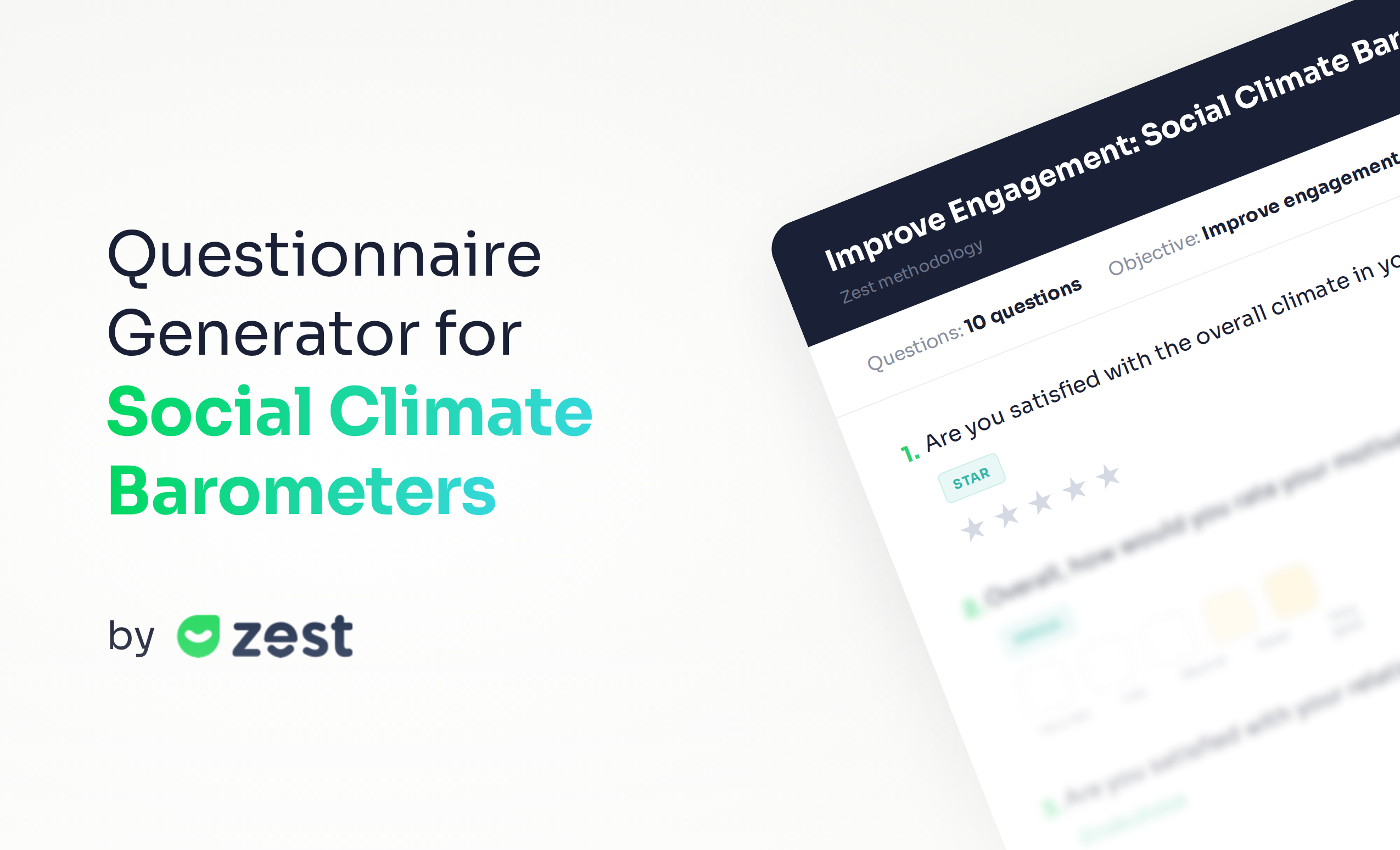
FAQ
Frequently asked questions about employee turnover
Employee turnover is the HR metric that measures how much an organization’s workforce is renewed over a given period, usually a calendar year. It takes into account both employee departures and new hires.
There are two methods. The INSEE method: [(hires + departures) ÷ 2] ÷ average headcount × 100. The simpler operational method: (departures ÷ average headcount) × 100. The first is used for national comparisons, the second for day-to-day internal HR management.
According to INSEE, it is around 15% per year, with wide variations across industries: below 5% in the civil service and up to 50% in the restaurant sector.
Poor management, a lack of career development opportunities, deteriorating working conditions, uncompetitive pay and poorly prepared onboarding are among the most common causes of high turnover.
The cost of a departure combines direct costs (recruitment, training, severance) and hidden costs that are often heavier (lost productivity, lower motivation among remaining teams and loss of expertise).
A turnover rate between 5% and 10% is generally considered healthy in most industries. Below 5%, the organization stagnates. Above 15%, turnover becomes a concern.
The most effective levers for reducing turnover are careful onboarding, hands-on management, clear career development opportunities, a smooth organization of work and regular monitoring of the social climate using dedicated tools.


