The social climate barometer: a questionnaire to measure your company’s social climate
Measure social climate and act before problems become costly.
What is a social climate barometer?
The social climate barometer is an internal questionnaire that measures social climate, employee engagement and management quality within a company.
For management, it primarily turns employee sentiment into indicators they can act on. Rather than relying on impressions or on signals that surface too late, companies can regularly measure engagement, internal communication and management quality.
Used well, the social climate barometer becomes a genuine growth tool (see how to measure its ROI here).
In this guide, you will discover:
When and why to launch a social climate barometer
How to build a questionnaire suited to your objective
And how to analyse the results so you can act on them
A free tool to generate your questionnaire based on your HR objective.
1
Choose your HR objective
2
Select the number of questions
3
Generate your personalised questionnaire
Free · No sign-up required
Why run a social climate barometer?
The main risk to talent retention is not disengagement itself. It is that disengagement stays invisible.
Turnover can be observed. Absenteeism can be measured. But gradual demotivation, loss of meaning and the silent erosion of the manager-employee relationship show up in no standard HR report. Yet these issues are far from rare: according to the 2024 BaromEX by Zest study, conducted among 1,207 representative French employees, only 37% say they are happy to get up in the morning to go to work, and 23% are considering leaving their company within the next twelve months.
Globally, Gallup's State of the Workplace 2026 places France at 8% effective engagement, compared with a global average of 23%. These figures do not surface spontaneously in everyday operational data. They only become visible once you measure them.
The most deteriorated lever in the 2024 edition, in continuous decline for two consecutive years.
Retention
Intention to stay
Considering leaving within 12 months
23%
Among 18 to 24 year olds, the loyalty score drops to 5.5/10: attrition risk is particularly concentrated among young talent.
Employer advocacy
Recommendation & recognition
Average eNPS
21% promoters · 38% detractors
−17.1
Feel recognised at their true value
50%
A negative eNPS means detractors outnumber promoters, with a direct impact on employer brand.
This is where the value of the social climate barometer lies. Not as yet another measurement tool, but as a way to reveal what, by nature, escapes traditional indicators. Organisations that rely solely on turnover or exit interviews to manage retention are inevitably working a step behind.
The social climate barometer gives HR decision makers a factual basis to prioritise their actions and measure their impact over time.
Zest social climate barometer's 5 objectives
✔ Measure satisfaction
Satisfaction is the most holistic indicator of employee experience.
It brings together clarity of objectives, the manager relationship and overall company climate into a single, general health index.
In short: the central, overarching indicator that serves as a benchmark for everything else.
✔ Anticipate turnover
The cost of an unanticipated departure always outweighs the cost of preventing it.
This objective draws on the manager relationship, the autonomy granted and team atmosphere to detect early signs of dissatisfaction before they turn into resignations.
In short: spot frustrations early to retain talent before they resign.
✔ Prevent psychosocial risks
Psychosocial risks build up silently through everyday imbalances.
This indicator directly assesses sustained work pace, requests outside working hours, contradictory instructions and work-life balance.
In short: detect hidden overload and burnout before they turn into a crisis.
✔ Improve engagement
Engagement determines whether the small details that make a real difference get addressed or ignored.
It is measured through concrete levers such as the sense of purpose found in one's work, recognition of effort by management and transparency in internal communication.
In short: activate concrete levers, purpose and recognition among them, that turn motivation into performance.
✔ Gain visibility
Growth brings more complexity and more distance between management and what is actually happening on the ground.
This objective captures, without filters, whether resources are adequate, how safe employees feel and how smoothly teams work together.
In short: remove hierarchical filters to give leaders an honest picture of your company's reality.
Social climate barometer, engagement survey, QWL survey: what is the difference?
The social climate barometer is the comprehensive tool that can be broken down into an engagement survey, a satisfaction survey (also known as a quality of working life survey, QWL/QVCT) and the rest of Zest's 5 objectives.
What it measures
Social climate barometer
Engagement survey
QWL survey
Engagement
✔
✔
✘
Management
✔
✘
✘
Communication
✔
✘
✘
QWL / QVCT
✔
✘
✔
Motivation
✔
✔
✘
Stress & psychosocial risks
✔
✘
✔
When should you use a social climate barometer?
1. You are managing for the long term
Disengagement usually creeps in almost imperceptibly.
Rather than a crisis tool, the barometer first serves to make visible a mechanism that is critical to your success.
2. Results have stalled*
When the usual levers stop improving performance, the human factor becomes the most likely explanation.
3. Your company is going through a turning point
Rapid growth, recovery from a crisis, a change in strategic direction... any moment when team sentiment shifts quickly exposes the organisation to risks worth measuring.
Warning signs are already visible
By the time warning signs become visible, rising turnover, growing absenteeism, perceptible tension within teams, the organisation is already behind. At this stage, the social climate barometer no longer works as prevention. It becomes a way to build a structured diagnosis, identify priority levers and launch corrective action on factual rather than intuitive grounds.
*Disengagement carries a quantified financial cost. IBET estimates that in France, undetected disengagement costs €14,310 per employee per year. A social climate barometer therefore comes with a measurable ROI 👉 Try the Zest social climate barometer ROI calculator →
How do you build your social climate barometer questionnaire?
Our questionnaire generator is in this section. Start by identifying your objective below.
1. Set your objective
Zest's 5 social climate barometer objectives align with the situation you are in.
You are in a situation of...
Recommended social climate barometer objective
Continuous improvement
Measure satisfaction
Stalling results
Improve engagement
Turning point
After a crisis or tense period
Measure satisfactionPrevent psychosocial risks
During a period of rapid growth
Measure satisfactionVisibility on the ground
During organisational change
Visibility on the ground
Warning signs
Rising turnover
Anticipate turnover
Growing absenteeism
Prevent psychosocial risks
Perceptible tension
To be defined with a Zest expert
Enter your objective into our free social climate barometer questionnaire generator
Free tool · Zest methodology
Create your social climate barometer questionnaire
Personalised to your HR objective, in under 2 minutes.
Here is an example Zest social climate barometer questionnaire for the Measure satisfaction objective, generated using the tool above.
You will notice several question types:
Weather. A 5-point visual scale (Very bad, Bad, Average, Good, Very good) shown as weather icons. Designed to capture overall emotional sentiment without over-intellectualising the response.
Single choice. A single-choice question with 4 answer options phrased as levels of satisfaction or frequency (e.g. Very satisfied to Not at all satisfied, or Always to Never). Equivalent to a Likert scale, made easier to read.
Smiley. A 5-emoji visual scale ranging from clear dissatisfaction to full satisfaction. More immediate than text, particularly well suited to questions about wellbeing or perceived usefulness.
Star. A 1 to 5 star rating. A universal format, used for questions on overall satisfaction or company climate.
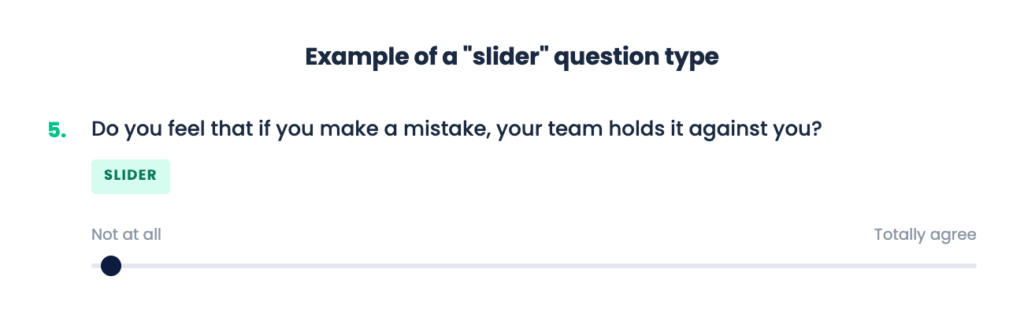
Slider. A sliding linear scale between two poles (e.g. Not at all / Completely agree). Suited to nuanced perception questions or questions about agreement with a statement. Example below:
Exemple de question type "curseur"
Has your questionnaire been generated ?
This isn't over yet! Distribution, analysis and the action plan are just as critical to the success of your survey. Keep reading to learn more.
How to communicate about a social climate barometer?
Communicate before launch
A short message from leadership explaining why the barometer is being launched and what will be done with the results significantly increases both participation rates and how honest the answers are. Without it, employees tend to self-censor or simply not respond.
Communicate results
This is the most overlooked step, and the most decisive one. If employees do not know what you did with their answers, they will not respond to the next barometer. A simple message is enough: what you learned, what you plan to do, what you cannot change and why.
Aim for a minimum participation rate
Below 60%, or below a minimum number of respondents, results become biased. A few simple levers help: a response window of 7 to 10 days, a mid-point reminder, and a reminder from the direct manager, without any pressure.
Should you wait until things calm down?
No, and this is the most common misconception. In periods of tension or transformation, the barometer is precisely where it is most useful: it puts into words what everyone feels but no one says. The one real reason not to launch it is launching it without any intention of acting on the results.
☝️ Zest lets you track participation rates in real time and send reminders to non-respondents without breaking anonymity.
Analysing the results of your social climate barometer
You have your data. Here is how to avoid missing what matters most.
Start with the gaps, not the average
An overall average hides as much as it reveals. One team at 4.8 and another at 2.1 produce a 3.4 that means nothing on its own. Start by looking for disparities between teams, departments and employee profiles.
Read the results at four levels
By participation rate. Below 60%, ask yourself why people did not respond. That, in itself, is a data point.
By indicator. Group questions by theme to identify healthy areas and areas of tension.
By segment. Cross-reference with seniority, department and employment status. A management issue may affect only one team.
By open-ended questions. Verbatim comments are often more revealing than scores. A word that comes up ten times is a strong signal.
Reference
Score
Interpretation
4.5 – 5
Strength to maintain
3.5 – 4.4
Satisfactory, worth monitoring
2.5 – 3.4
Area of concern, worth investigating
< 2.5
Warning sign, priority action
Do not react to a single question in isolation
A low score on one question alone can have dozens of explanations. Wait until several questions within the same indicator confirm the signal before acting.
Prioritise by impact and feasibility
You will always have more areas for improvement than capacity to act on them. Prioritise what has the greatest perceived impact for employees and the greatest feasibility for the company. For everything else, communicate. Do not stay silent.
From analysis to action: what should you do based on the signal you detect?
Low scores only matter if you know what to do with them. Here are the most common signals and what the research concretely recommends.
Signal
What it reveals
Recommended action
Low score on "my manager listens to me / supports me"
A management posture issue. HR research estimates that 60 to 70% of the variance in a team's engagement is directly attributable to the direct manager. Management
Training in feedback and management coaching. Priority: clarity of priorities, continuous feedback, team empowerment.
Low score on "I understand the strategy / the decisions"
A gap in top-down communication. According to BaromEX 2024, fewer than one employee in two says they feel well informed about ongoing changes within their company. Communication
Regular town halls, a leadership FAQ, proactive communication on decisions and the reasoning behind them.
Low score on "I feel recognised"
A lack of systematic positive feedback. BaromEX 2024 found that only 50% of French employees feel recognised, the first action lever identified. Recognition · BaromEX 2024
Manager recognition rituals, peer-to-peer feedback, celebration of collective wins.
Low score on "I have development opportunities"
A lack of visibility into career paths. BaromEX 2024 shows that only 52% of employees feel effectively supported in their development. Development · BaromEX 2024
Development conversations, visible internal mobility, individualised training plans.
Low participation rate (< 60%)
A loss of trust in the process, a signal in itself. Participation
Share the results of the previous barometer, and show what has changed since.
Prioritisation rule: do not address more than 1 to 3 items at a time. Choose the lowest scores and build the action plan with the team, not for it.
👉 Learn more about how to interpret your results in our full guide to analysing social climate barometer results.
How often should you run a social climate barometer?
The short answer: more often than you probably do.
The annual barometer remains the norm, but that is also its main weakness. A year is a long time. A reorganisation, a change of manager or a period of tension can arise and resolve itself between two waves without you ever measuring it.
The most advanced organisations combine two rhythms:
Structured barometer
Annual or biannual, comprehensive, with results shared back and an action plan. This is your baseline snapshot.
Pulse surveys
3 to 5 questions, monthly or quarterly, focused on a specific indicator. This is your real-time thermometer. They do not replace the barometer, but they help catch a weak signal before it becomes a crisis, or dig deeper into a specific topic.
The real constraint is not willingness. It is operational workload. This is why most HR teams stick to once a year, not as a strategic choice but for lack of a suitable tool. Zest lets you schedule and automate barometers and pulse surveys from a single platform, making a more frequent rhythm sustainable without extra resources.
The trap to avoid: running a barometer with no follow-through
This is the most common, and most costly, mistake.
Launching a social climate barometer and then communicating or changing nothing will cost you employees' trust and engagement. The quality of your future barometers will suffer as a result.
It is simple: do not launch a barometer unless you are ready to communicate the results and act on at least one point.
This raises a question worth considering about how often you run your barometers. An annual barometer creates an implicit pressure to fix everything within a year. Regular pulse surveys let you act through small iterations, show teams that their feedback has an effect, and sustain trust in the process over time.
Zest is built for this. Schedule barometers and pulse surveys from a single platform, track action plans, and measure whether things have changed by the next round. Not to run more surveys. To close the loop.
👉 Want to send your questionnaire directly to your teams and analyse the results automatically?
Where can I find examples of social climate barometers?
The most accessible examples are in the questionnaire generator available on this page, which offers five standard structures based on your HR objective. ANACT and ANDRH also publish reference resources on employee listening practices. For a sector benchmark, BaromEX by Zest provides annual data based on 1,207 representative employees. Zest also offers a library of templates designed by its work psychology experts, which can be adapted to your context.
Does the social climate barometer need to be anonymous?
It depends on your objectives. Anonymity helps ensure sincere, unbiased answers, which improves the quality of the data collected. Conversely, non-anonymous answers allow for individual follow-up and personalised action plans.
Can Zest guarantee the anonymity of responses?
Zest lets you configure survey anonymity using 3 models: anonymous for everyone, respondent's choice, or public answers only. You can also set a minimum number of respondents to protect confidentiality. arantir la confidentialité.
Are there sector-specific social climate barometers?
Yes, sector-specific social climate barometers exist and are adapted to the particular challenges of different industries, so they capture what matters most for each one. The Zest suite lets you create tailored social climate barometers to meet the specific needs of any company, regardless of its industry.
What is QVT/QVCT?
QVT, or QVCT (Qualité de Vie et des Conditions de Travail), refers to the full range of actions and conditions that reconcile better working conditions with the company's overall performance.
What other actions can be taken to measure QWL/QVCT?
To effectively measure Quality of Working Life (QVCT), several complementary actions can be put in place: - Annual questionnaires - Pulse surveys - eNPS (Employee Net Promoter Score) - Dashboards and tracking indicators - Direct observation - Dynamic management tools
In this context, Zest offers an integrated approach to measuring and improving QWL: - Daily mood: A feature for regularly tracking employee morale. - Pulse surveys: Short, targeted surveys on specific topics such as onboarding or company culture. - Engagement survey: A ready-to-use tool for measuring engagement and motivation levers. - Customisable surveys: For building tailored surveys suited to the company's specific needs. - Social climate barometer: A comprehensive tool that assesses social climate and tracks engagement over the long term. - Suggestion box: Encouraging employees to share ideas for improving QWL.
Zest and its partners use cookies or similar technologies and process personal data which may be cross-referenced with information provided as part of our services for the following purposes: to improve your user experience, to carry out audience statistics and studies to improve our offers, to provide you with services tailored to your interests, to display targeted advertising on our site or those of our partners, and to measure the performance of such advertising. Some cookies are necessary for the operation of the site and our services. You can accept, manage your preferences by purpose or continue browsing without accepting.
 1. You are managing for the long term
 2. Results have stalled*
 3. Your company is going through a turning point
 Warning signs are already visible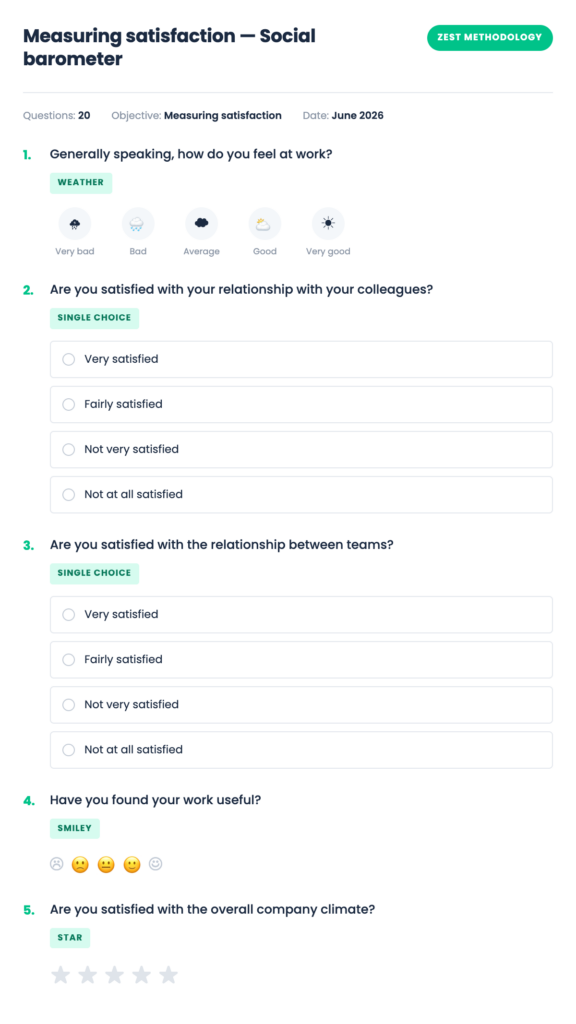
 Communicate before launch