The OKR Method: Clear HR objectives and measurable results
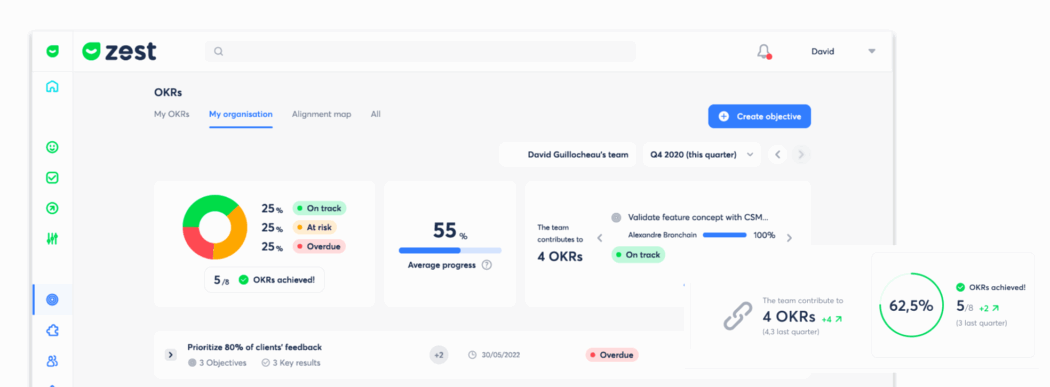
Zest makes it easy to implement the OKR (Objectives and Key Results) method across all levels of the organization. Each team defines its individual and collective OKRs based on the company’s overall goals and links them to measurable key results.
What are OKRs?
It’s a simple management practice that aligns every goal within the organization around a shared and ambitious vision.
The idea is straightforward: set a clear objective and define key results to measure progress. This turns your strategy into clear, actionable steps, with company-wide alignment and consistency.
Request a demo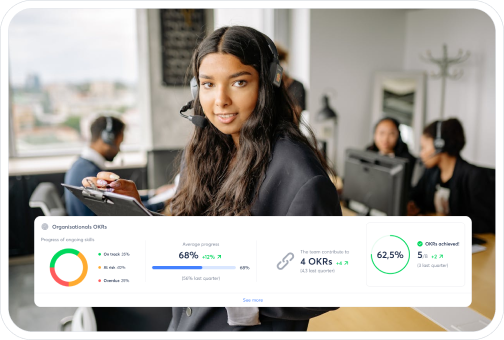
The story behind OKRs
The OKR method as we know it today originated in the United States in the 1950s. It was formalized by Andrew Grove, then CEO of Intel, and later introduced at Google in 1999 by John Doerr. Since then, major companies like Netflix, Amazon, Twitter and IKEA have adopted OKRs, contributing significantly to their success and helping popularize the concept worldwide.
How to implement the OKR method with Zest (step by step)
Give meaning to everyone’s role
It’s essential to provide your teams with a clear framework. For example, by aligning their individual and collective goals with your company’s strategy and purpose.
Encourage teams to work together toward shared objectives to strengthen team spirit.
Empower your people with key results that contribute directly to your company’s performance.
Empower your people
Involve your teams in defining their own objectives and the key results that go with them.
Give employees the autonomy to choose the actions and resources they’ll use to reach their OKRs.
Foster collective intelligence by encouraging cross-functional collaboration and mutual support.
Support your people on the path to success
Strengthen manager-employee communication to enable ongoing coaching and support.
Schedule regular check-ins with your teams to quickly identify and remove roadblocks or frustrations.
Adopt an agile and empowering management approach that drives performance.
Why use OKRs? What are the benefits?
OKRs are a highly effective tool to achieve:
1
Alignment and consistency
Between the company’s strategic goals and the objectives of each team and individual.
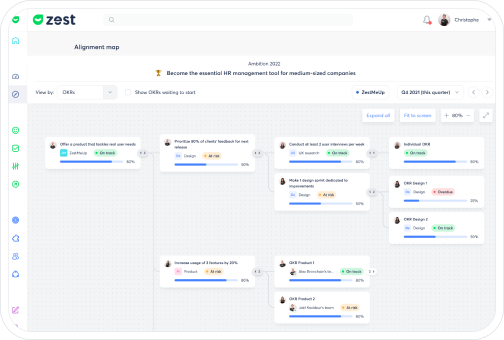
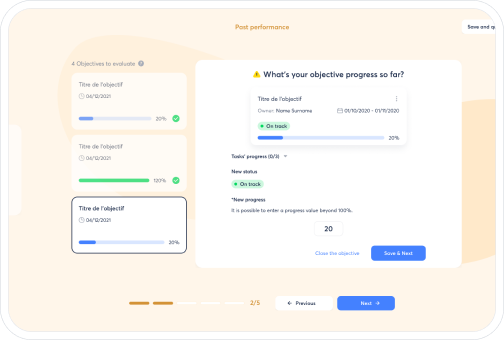
In Zest, OKRs can be created quickly and easily by any employee or manager. The alignment map gives everyone a real-time, company-wide view of all OKRs and their progress.
2
Agility
In ensuring consistency between goals and day-to-day execution, and between objectives and the evolving realities of the business.
In Zest, OKRs are reviewed regularly, typically monthly or quarterly, during team rituals or 1:1 meetings to stay aligned with day-to-day changes.
3
A sense of purpose and team engagement
By empowering everyone to define their own key results and the means to achieve ambitious goals. The OKR method embraces the right to fail as part of its DNA, encouraging individuals to push their limits and aim high.
Zest adapts to your organization. OKRs can be managed by each employee or centralized at the HR and management level.
How to set effective objectives and key results?
Goal setting is at the heart of the OKR method. It’s about defining ambitious objectives that will drive the company forward, while still being achievable.
In the American approach, the level of ambition is intentionally high: “Shoot for the moon!” It’s a positive psychological mindset that encourages people to aim big, embrace stretch goals, and accept the possibility of failure. Achieving 70% of a highly ambitious objective is considered a success, since fully reaching every goal is rarely expected in Google’s “Think Big” philosophy.
Each objective is tied to 3 to 5 Key Results. These should be measurable, time-bound, and quantifiable. This level of clarity helps teams define and track outcomes based on concrete, objective data.
Our OKR examples
 HR OKRs

Improve the candidate experience with the following Key Results: reduce average response time for rejected candidates from 10 to 5 days; Cut the number of interviews in the hiring process from 5 to 3; achieve a 100% satisfaction rate among shortlisted candidates.
Manager OKRs
Improve team performance and engagement with the following Key Results: increase the team’s individual goal completion rate from 74% to 89% by the end of the quarter; achieve a team satisfaction score of 90% or higher in the quarterly survey.
Team members OKRs
Strengthen customer satisfaction and loyalty by achieving the following Key Results: increase the Net Promoter Score (NPS) from 7.5 to 8.5 out of 10 by the end of the quarter; reduce average response time to customer requests from 24 hours to 12 hours.
OKRs and HR
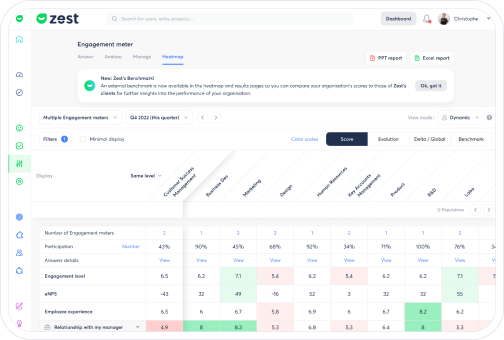
HR teams play a key role in driving the company’s accelerated transformation. Heavily relied on during the health crisis, Human Resources must now focus on employee well-being and engagement while supporting overall organizational performance.
OKRs can be applied across all HR areas: payroll, recruitment, onboarding, internal mobility, talent management, employee satisfaction, engagement, turnover reduction, quality of work life, company culture, training, and more.
The OKR method: common mistakes to avoid
 Setting too many objectives or key results

One of the core principles of the OKR method is to set bold, ambitious goals to guide your team and drive the organization forward. A common pitfall is treating day-to-day operations as OKRs. Another is setting too many Key Results, which waters down your focus, spreads your efforts thin, and puts your primary goal at risk.
 Linking OKRs to individual bonuses

A missed objective should never lead to a penalty. By design, OKRs should not be tied to bonus systems, as full autonomy is essential to set truly ambitious goals and foster innovation. Linking them to compensation naturally limits risk-taking and discourages bold initiatives.
 Not delegating ownership

One of the keys to successful OKRs is empowering team members to define and take ownership of their own objectives. OKRs should be developed collaboratively during team meetings or brainstorming sessions. It’s essential to create a culture of trust where mistakes are allowed and seen as part of the process.
How can you track your OKRs in real time?
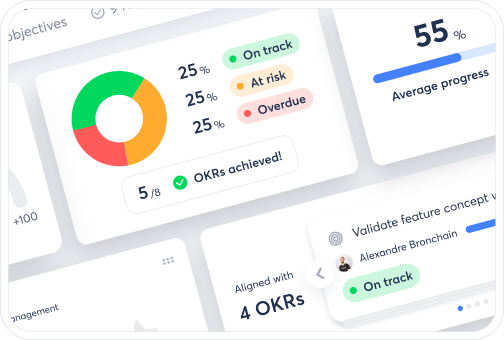
In Zest, you can update your Key Results based on your progress, with OKR tracking set either manually or automatically. The alignment map gives you a clear, company-wide view of all OKRs and how they connect.
What types of companies is the OKR method best suited for?
Any company can implement the OKR method, regardless of size or industry. One of the key success factors is strong leadership support and a commitment from top management to embed the method over time.












FAQ
Do you have any questions?
What does the acronym “OKR” stand for?
OKR stands for Objectives and Key Results. This method helps define both individual and team OKRs based on the company’s overall goals, and ties them to measurable Key Results.
Who created the OKR method?
Originally developed in the 1950s, the OKR method as we know it today was formalized by Andrew Grove, then President of Intel.
It was later popularized and introduced at Google in 1999 by John Doerr.
Since then, this goal-setting framework has proven its value and has been adopted by leading companies like Netflix, Amazon, and Twitter.
OKRs vs KPIs: What’s the difference?
OKRs vs KPIs: What’s the difference?
OKRs are not KPIs! OKRs define where you want to go, while KPIs measure what has already happened.
OKRs are forward-looking goals, whereas KPIs focus on past performance. That said, your Key Results should follow the SMART framework: they need to be Specific, Measurable, Achievable, Relevant, and Time-bound.
How do you build effective OKRs?
It all starts with a clear company vision and a bold but achievable corporate OKR.
This company-wide OKR is then cascaded into departmental or team OKRs, and finally into individual OKRs.
Each Objective is supported by 3 to 5 Key Results that must be clearly defined, measurable, and time-bound.
Every team member is actively involved and empowered in the process of defining their OKRs, which are reviewed regularly to stay aligned and on track.
What are some OKR examples for HR teams?
Here’s an example of an OKR related to recruitment. Objective: Improve the recruitment process to boost candidate satisfaction. Key Results include reducing the average response time for rejected candidates from 10 to 5 days, cutting the number of interviews in the hiring process from 5 to 3, and achieving a 100% satisfaction rate among shortlisted candidates. Another OKR could be focused on increasing employee satisfaction. In this case, the Key Results would be to collect improvement suggestions from 20 employees and implement them, reach an eNPS (Employee Net Promoter Score) above 8, and rank among the top 10 companies on Glassdoor.
More Zest news
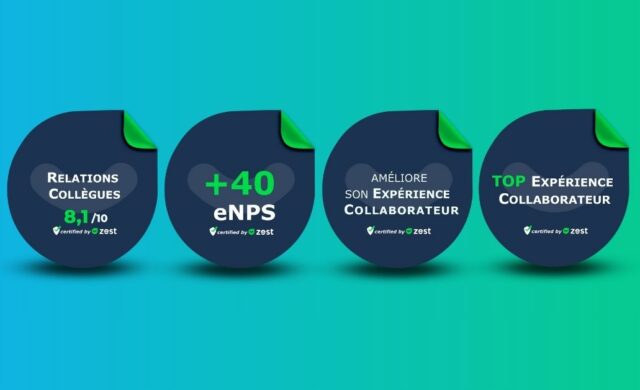
Zest launches its Labels!
Zest launches different types of labels to promote companies’ HR commitment

Pulse Surveys: Definition, Sample Questions and How to Get Started
Pulse surveys are a type of HR survey that allow you to assess employee satisfaction, commitment and development through regular surveys.
So why have these surveys become an essential part of the HR toolbox?

How to Improve Human Resource Management (HRM) in Your Company
Modern HRM puts people at the heart of performance. Explore its key levers for balancing productivity and quality of working life.
Allow all cookies
Continue without accepting

Zest respects your privacy
Zest and its partners use cookies or similar technologies and process personal data which may be cross-referenced with information provided as part of our services for the following purposes: to improve your user experience, to carry out audience statistics and studies to improve our offers, to provide you with services tailored to your interests, to display targeted advertising on our site or those of our partners, and to measure the performance of such advertising. Some cookies are necessary for the operation of the site and our services. You can accept, manage your preferences by purpose or continue browsing without accepting.
Cookie settings
Allow all cookies
