Absenteeism at Work: Causes, Costs and Solutions to Reduce Your Absence Rate

Article summary
According to a study by the Institut Sapiens, absenteeism costs French companies an average of nearly €108 billion a year (excluding COVID-19). Employee absenteeism has become commonplace in the workplace. Despite the drastic measures HR directors may take, the situation remains alarming. So how can you reduce absenteeism at work? What does effective absence management look like? Here are some answers.
What Is Absenteeism at Work?
Absenteeism at work refers to an employee’s repeated or prolonged absences from their job, excluding paid leave and absences provided for by law (maternity leave, professional training, etc.). It covers sick leave, workplace accidents and unjustified absences, but also frequent lateness and early departures, which add up and weigh just as heavily on the organization.
It is more than just an HR metric. A high absenteeism rate is often the symptom of a deeper problem: deteriorating working conditions, poor management or disengaged teams. Understanding it is the first step toward taking action.
Avoidable vs. Unavoidable Absenteeism: A Key Distinction
Not all absences are equal, and they cannot all be addressed in the same way. There are generally two broad categories:
- Unavoidable absenteeism, linked to causes over which the company has little or no control: serious illness, accidents, maternity leave.
- Avoidable absenteeism, which a well-designed HR policy can genuinely influence: stress, disengagement, working conditions, a poor atmosphere or a lack of recognition.
This second category is where HR leaders should focus their attention, because it is where prevention delivers measurable results.
The Different Types of Absenteeism
To manage the issue effectively, it helps to categorize absences by duration and frequency:
- Short-term absenteeism (1 to 3 days), often a sign of discomfort at work or a temporary drop in motivation.
- Medium-term absenteeism (4 to 30 days), usually linked to musculoskeletal disorders or a more acute episode of stress.
- Long-term absenteeism (more than 30 days), which weighs most heavily on costs and business continuity, and is frequently associated with burnout or psychosocial risks.
- Micro-absenteeism: lateness, half-days taken at the last minute, extended breaks. A weak signal that too often goes unnoticed on HR dashboards, yet deserves just as much attention.
What Is the Average Absenteeism Rate in France? Key Figures
The barometers published every year by Malakoff Humanis, Ayming and Willis Towers Watson all point to the same conclusion: absenteeism rose sharply after 2020 before stabilizing at a high level.
- The average absenteeism rate in France now stands at around 5.5 to 6%, compared with 4.7% before the COVID-19 pandemic.
- According to the Institut Sapiens, it costs French companies around €108 billion a year, or nearly 4% of GDP.
- At the individual level, this represents an average of more than €4,000 per employee per year.
- Psychological disorders (stress, anxiety, burnout) now rank among the top three causes of sick leave, on a par with musculoskeletal disorders.
- Some sectors, such as healthcare, transport, retail and home care services, have rates well above the national average.
These figures confirm a long-term trend. Absenteeism is no longer an occasional issue but a structural HR management challenge, one that needs to be measured closely, department by department.
How to Calculate Your Company’s Absenteeism Rate
Before trying to reduce absenteeism, you first need to measure it accurately. This measurement is what will allow you to track the impact of your actions over time.
The Absenteeism Rate Formula
The standard formula for calculating the absenteeism rate is:
Absenteeism rate =
This calculation can be carried out monthly, quarterly or annually. For truly useful HR management, it is best broken down by department, age group or length of service. This level of detail is what turns a raw figure into a genuine decision-making tool.
Absenteeism Rate Calculation Example
Take a company with 100 full-time employees. Over a given month, its teams record a total of 500 hours of absence, against 22,000 theoretical hours worked.
The absenteeism rate is therefore (500 / 22,000) x 100, or around 2.3%. Compared with the national average of 5.5%, this is a fairly good result. However, it should always be tracked over time: a rate that looks stable can conceal a sharp increase in a particular department.
Which Absences to Include or Exclude
Which absences you include depends on the goals of your analysis, but some rules are widely accepted.
Planned or scheduled absences, such as paid leave, maternity leave or professional training, are generally excluded from the calculation.
Conversely, sick leave, workplace and commuting accidents, and unjustified absences are included, as they are the clearest indicators of the organization’s social climate.
What Is the Hidden Cost of Absenteeism?
This is often a blind spot for companies. Beyond the national figure of €108 billion, few HR departments can accurately estimate what absenteeism actually costs them.
The direct and indirect cost of absenteeism
Direct cost
All the expenses directly tied to an employee’s absence.
- Continued salary
- Social security contributions
- Supplementary sick pay
- Temporary staff
- Overtime
Calculation
Days of absence × average daily cost per employee (gross salary plus employer contributions)
Indirect cost
The knock-on effects of absence on the organisation and its teams.
- Lower productivity
- Team overload
- Project delays
- Loss of skills
- Poorer service quality
A vicious circle
How to Estimate the Cost of Absenteeism in Your Company
To get a reliable picture of the true cost, cross-reference three data points:
- The absenteeism rate calculated above
- The average fully loaded daily cost per employee
- A reasonable estimate of indirect costs (replacement, lost productivity)
Even an approximate approach like this is enough to demonstrate the scale of the issue to your leadership team and justify a prevention budget.
What Causes Absenteeism at Work?
Understanding the causes of absenteeism is the first step toward reducing it over the long term. The reasons are many and often interlinked, and call for an organization-wide rather than case-by-case approach.
Physical Health Causes
Musculoskeletal disorders remain one of the leading causes of sick leave in France. Awkward postures, heavy lifting, repetitive movements and poor ergonomics lead to absences that are often long and costly. Workplace and commuting accidents complete the picture, particularly in the industrial and logistics sectors.
Stress and Psychosocial Risks
Excessive workload, unresolved conflicts, loss of purpose: psychosocial risks have risen sharply in recent years and now account for a growing share of both short- and long-term absences. When the root cause goes unaddressed, chronic stress leads to repeated absences, and eventually to burnout.
Management and Organizational Causes
Poor, absent or badly structured management has a direct impact on a team’s absenteeism. Conversely, attentive management that recognizes employees’ work and can pick up on weak signals significantly reduces avoidable absences.
Disengagement: An Often Underestimated Cause
Disengagement is probably the least visible cause, yet one of the most common. Employees who feel neither useful, nor recognized, nor aligned with their company’s values gradually withdraw. Absenteeism then becomes the tangible expression of disengagement that set in long before. This is precisely the stage at which a continuous listening approach allows you to act, before the situation turns into sick leave.
What Are the Consequences for Your Company?
High absenteeism is never just a line on an HR dashboard. It disrupts day-to-day operations, increases the workload of employees who are present and can weaken an entire team.
The most commonly observed consequences include:
- Lower productivity
- Project delays
- A deteriorating social climate
- Higher turnover
- In some sectors, a drop in quality as perceived by customers
These effects, which are hard to quantify precisely, come on top of the direct and indirect costs described above. On their own, they justify a structured prevention policy.
How to Reduce Absenteeism at Work: The Levers That Work
Reducing absenteeism doesn’t happen overnight. It is the result of a coherent strategy that combines employee listening, prevention, manager training and data-driven management. Here are the levers that have proven their worth.
Set Up Continuous Employee Listening
Unlike an annual survey, which provides a delayed snapshot, continuous listening regularly captures how teams feel about their workload, their management and their engagement. It allows weak signals to be detected in real time, before they turn into sick leave. This is precisely the approach Zest offers through its surveys and social climate barometer.
Improve Quality of Life and Working Conditions (QWLC)
Quality of Life and Working Conditions (QWLC) encompasses workstation ergonomics, work-life balance, remote work and risk prevention. Investing in QWLC is not an unnecessary expense. It directly helps reduce absenteeism and improve productivity.
Train Managers in Prevention and Return-to-Work Interviews
Frontline managers are the first line of prevention. Training them to spot weak signals, conduct return-to-work interviews after an absence and regulate their team’s workload is a high-impact lever. A well-equipped manager can often identify an employee who is struggling several weeks before they go on leave.
Recognize and Value Your Teams
Lack of recognition remains one of the most common causes of demotivation, and therefore of avoidable absenteeism. Acknowledging contributions, celebrating successes and clarifying the purpose of each role are simple, low-cost management practices, yet they are highly effective.
Track Absenteeism With the Right HR Metrics
You can only reduce what you measure. Managing absenteeism requires a dashboard shared between HR and operational teams, combining the overall rate, the rate by department, the average duration of absences, their frequency and their reasons. This cycle of measurement, analysis and action is what delivers a lasting reduction rather than a one-off improvement.
How Zest Helps You Prevent and Reduce Absenteeism
Prevent absenteeism with a free employee survey
A rise in absenteeism often hides weak signals: heavy workloads, loss of meaning, tension with managers or team fatigue. To spot them before they turn into sick leave, nothing beats listening directly to your employees. Our employee survey generator lets you create a tailored questionnaire in 2 minutes, built on the Zest methodology and over 500,000 pieces of employee feedback. Select the “Improve quality of life at work” objective and get questions validated by HR experts, ready to send to your teams.
Generate my free survey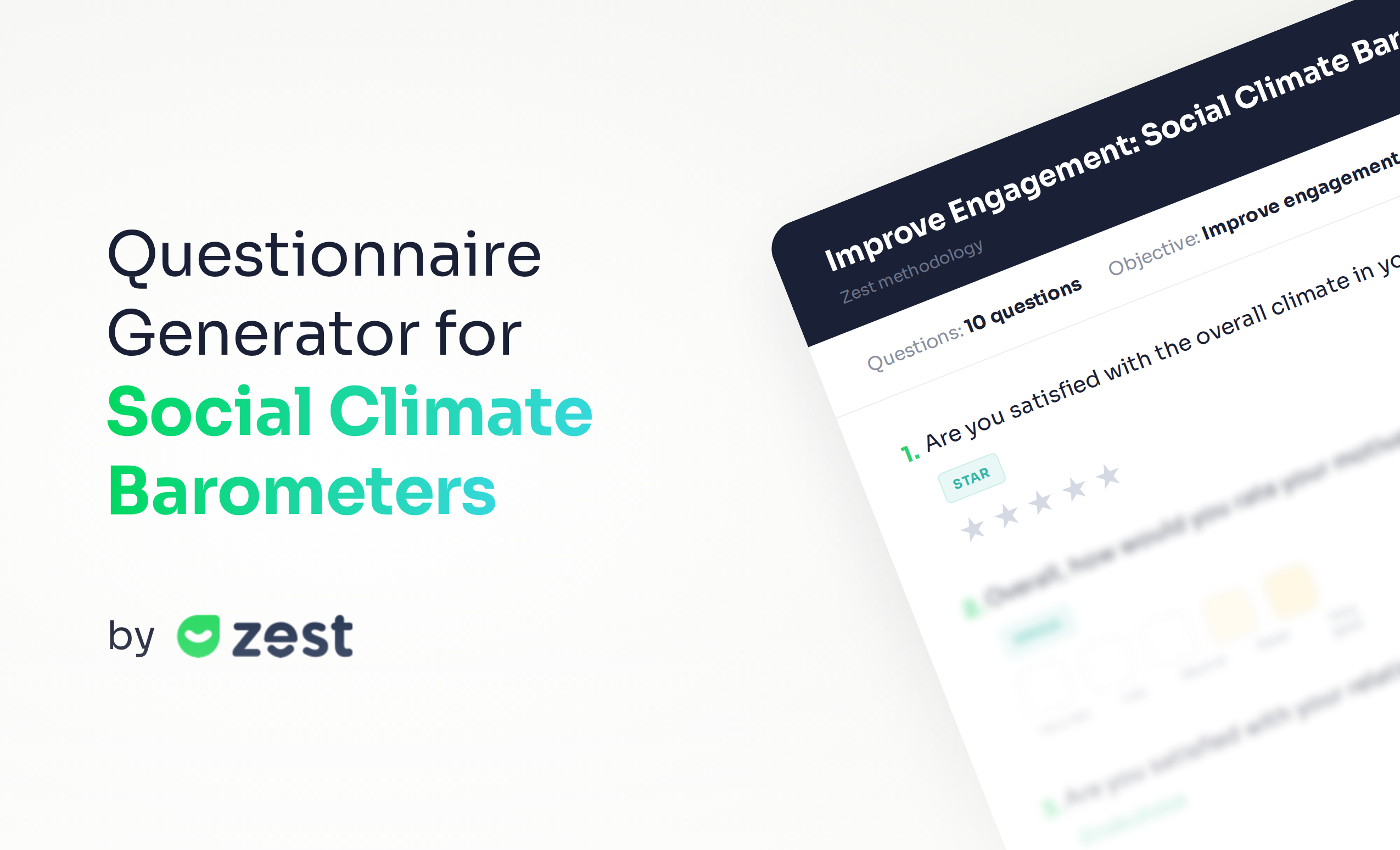
Most avoidable absences are preceded by weak signals: declining engagement, perceived overload, loss of purpose, tension within the team. The problem is that these signals don’t show up in any standard HR reporting. By the time the absence occurs, it is often too late to act preventively.
That is exactly what Zest changes. Our continuous listening platform helps you detect these signals before they turn into absences, understand their causes through in-depth analysis of employee feedback, and translate those insights into concrete action plans you can track over time.
Want to assess your exposure to absenteeism and turnover risk right now? Our Social Barometer questionnaire generator lets you create your own social climate barometer for free and anticipate both departures and prolonged absences.
Request a Zest demo and discover how to turn absenteeism management into a genuine driver of people performance.
Request your demoFAQ
Frequently Asked Questions About Absenteeism at Work
The average absenteeism rate in France currently stands at around 5.5 to 6%, according to the latest Malakoff Humanis and Ayming barometers. This rate remains about one percentage point higher than before 2020, driven in particular by the rise in sick leave linked to psychological and musculoskeletal disorders.
Divide the number of hours or days of absence over a given period by the number of theoretical hours or days worked over the same period, then multiply the result by 100. This calculation can be carried out monthly, then broken down by department for more detailed tracking.
Planned or scheduled absences, such as paid leave, maternity leave or professional training, are generally excluded from the calculation. Only absences that could have been avoided or anticipated, such as sick leave or unjustified absences, are taken into account.
The cost of absenteeism has two components. The direct cost is easy to quantify (continued salary payments, replacement, social security contributions). The indirect cost is less visible and stems from lower productivity, team overload and a deteriorating social climate. Nationally, absenteeism represents an average of more than €4,000 per employee per year.
The main weak signals to watch for are an increase in micro-absences, gradual withdrawal from team interactions, reduced initiative, irritability and declining engagement scores. A continuous listening approach helps identify these signals and trigger preventive action before sick leave occurs.
Yes, provided it is followed by concrete action. Companies that combine regular listening, feedback sessions with managers and targeted action plans generally see a significant drop in their absenteeism rate within 12 to 18 months. The benefits also extend to team engagement and retention.
Absence abuse accounts for only a small share of absences. Rather than relying on coercive measures, it is more effective to strengthen frontline management, introduce systematic return-to-work interviews and address the root causes of disengagement, which explain most repeated absences.


