Employee Experience:
Employee satisfaction at the company’s heart
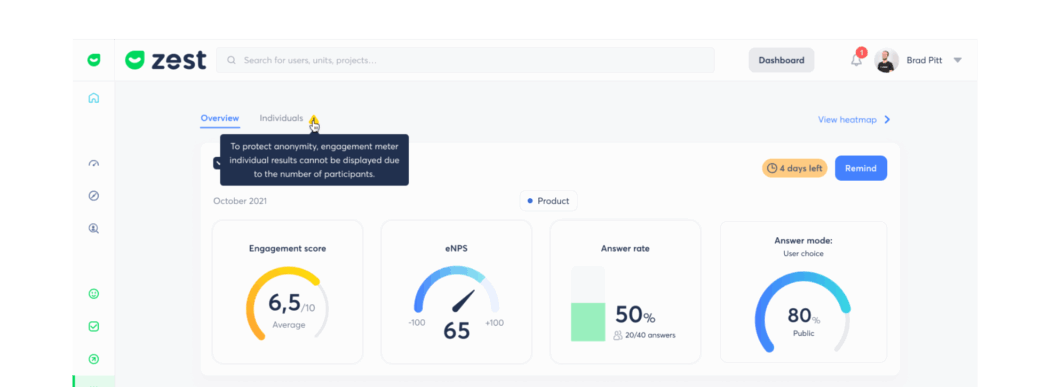
Zest’s web and mobile application makes it possible to offer a unique employee experience to all employees, whether at the office, working remotely, or out in the field. It is an HR and management tool designed to meet both employee expectations and the company’s performance objectives.
What is employee experience?
Definition and origin
Formalized in 2017 by Corinne Samama in the first book dedicated to the topic in France, “L’Expérience Collaborateur: Faites de vos employés les 1ers fans de l’entreprise!” (Diateino), employee experience broadly refers to the full range of perceptions, feelings, interactions, and experiences an employee has within the company’s ecosystem. This applies both to key moments in their journey and to their everyday professional life (work environment, responsibilities), from recruitment through to departure. Measuring it is therefore essential.

How do you measure employee experience?
 Social barometer

Tracks social climate and how engagement and wellbeing evolve over time. It also connects those trends to absenteeism and turnover, helping reduce both, and lets HR compare results year over year.
 360° feedback

One of the most effective ways to boost engagement and build a stronger sense of belonging. Zest’s digital suite makes 360° feedback simple to run at every level of the company.
 HR surveys

Take your teams’ pulse throughout the year to spot areas for improvement and act on them.
 Pulse surveys

Quick and agile, these capture how your teams are feeling in the moment, so you can respond fast.
Continuous feedback through Pulse surveys matters: it opens up conversation, reveals what actually motivates people, and clears out small frustrations before they build up.
What is at stake with employee experience?
Strengthening employee engagement
Employee experience and engagement go hand in hand. Recognition, work-life balance, and working conditions (including remote work) are all core drivers of engagement and motivation, and all part of employee experience.
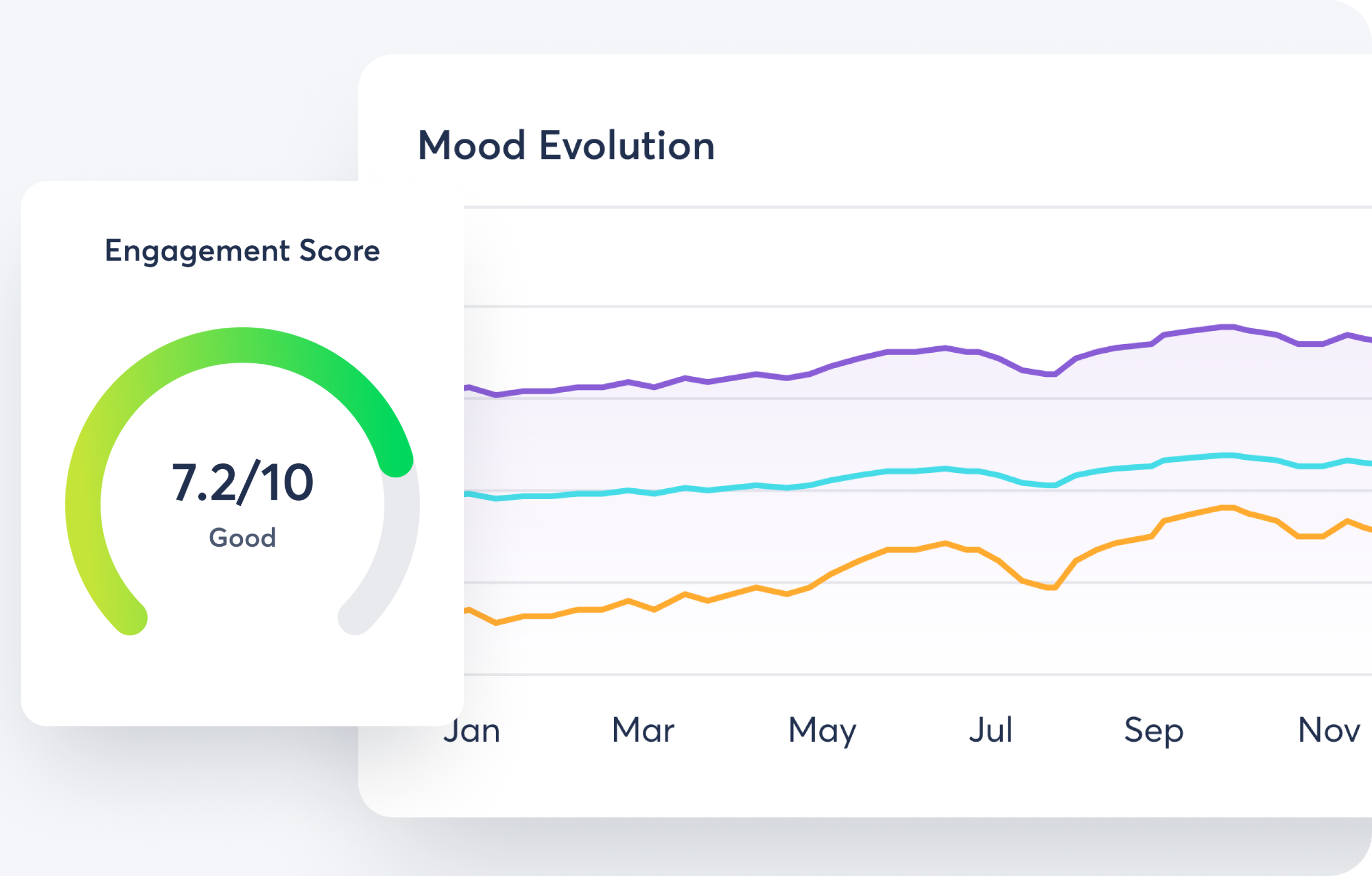
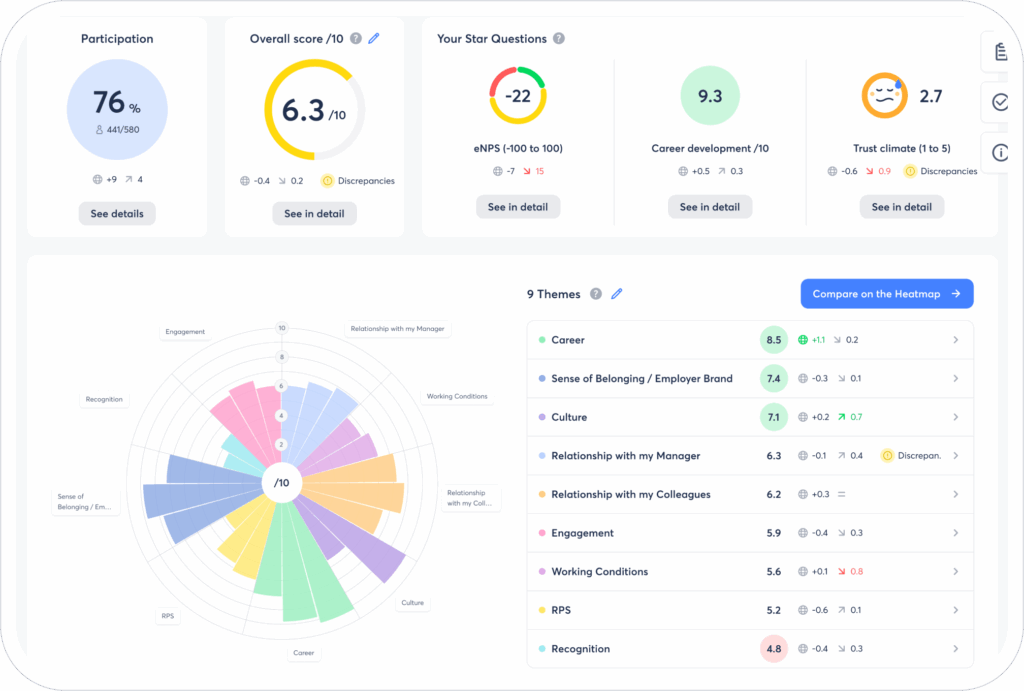
Zest’s Engagement Meter and Motivation Drivers features map engagement across the company as a heatmap, alongside a detailed breakdown of what’s driving it.

Building employer brand
Retaining talent: A strong employee experience keeps people around. It cuts turnover and everyday absenteeism, and retention is one of the biggest challenges companies face today.
Easier recruitment: A better employee experience also strengthens your employer brand, helping you attract new customers, talent, and partners. In a tight job market, a strong employer brand isn’t optional. It’s a must.

Improving work life balance
Employee experience and quality of work life feed each other directly: you can’t have wellbeing at work without a solid employee experience, and you can’t have a solid employee experience without quality of work life. An HR strategy built around employee experience helps people feel good, heard, less stressed, part of the team, and valued by their managers.
Improving customer satisfaction
This comes down to the symmetry of attentions: how a company treats its employees mirrors how it treats its customers. In practice, a strong employee experience shows up in better customer relationships, and in higher productivity and performance. A win across the board.

HR Directors: revolutionize employee experience with Zest, and make smarter decisions!
How do you give employees an optimal experience? In short, measuring it, combined with digital tools, is the winning combination and a genuine strategic asset for the company. And ultimately, it’s the most effective way to rethink management practices…
HR leaders: rethink your employee experience with Zest, and make sharper decisions
Employee experience
“Happy employees, happy customers” isn’t just a saying. It’s the foundation of reciprocal attention, and it means employee experience directly shapes customer satisfaction. The two mirror each other: one rarely thrives without the other. A great customer experience simply doesn’t happen without a great employee experience behind it, and that creates a virtuous circle that fuels the company’s performance.

Customer experience
Customer experience, sharpened by digital tools and the rise of participatory platforms, has become a strategic priority in its own right. It drives satisfaction and turns customers into loyal advocates. Done well, it’s both a real competitive edge and a strong point of differentiation.

Employee experience and wellbeing: how do you get it right?
Employee experience starts with wellbeing at work.
So pay attention. Listen to your people. Track how they’re feeling in real time so you catch early warning signs before they turn into a crisis. Where do you start?
 Mood
Mood
Survey
your teams with ready-made templates, so you can launch surveys in a few clicks and drive up participation.
Identify
what actually matters to your employees using the Engagement Meter and its 18 motivation drivers, developed by a psychometrics researcher.
Pace yourself
to match your capacity to act. Listening without following through doesn’t just fall flat. It can actively demotivate people. If you can’t act on the results, survey less often.
The payoff: a more productive, more engaged, higher performing team.
Drive engagement through continuous feedback
Every company owes its employees a unique, exceptional, genuinely engaging experience.
That means getting all three spheres of employee experience right (per the IBM Institute for Business Value): physical (the workspace itself), social (the quality of relationships), and organizational (HR resources and practices).
 OKRs
OKRs
Roll out the OKR method
to give everyone’s role real meaning by aligning individual objectives with the company’s.
Check in regularly
with your teams to clear out friction fast and help them succeed.
Support
each person’s skills growth and career development.
A feedback culture
is central to employee experience and to better performance overall: it’s what turns work into something genuinely meaningful.
Employee experience: build a culture that’s supportive and energizing
Build psychological safety into your teams.
Encourage people to share ideas, and actually act on them.
Build belonging by encouraging people to help each other and think together.
And don’t forget to say thank you: recognize your employees, and encourage them to recognize each other too.
 My Zest
Keep optimizing employee experience
Build a real process around it: dig into your survey results with powerful dashboards and word clouds that actually mean something.
Share results with employees through visuals, tables, and charts that are easy to read at a glance.
Bring employees into building action plans based on what they told you.
 Engagement Meter
What drives employee experience?

Dialogue and feedback
Ongoing dialogue and continuous feedback lay the groundwork for a strong employee experience. Regular conversation lets you get ahead of problems, solve them faster, and build a real feedback culture over time.
Zest’s feedback feature makes it easy to give positive or constructive input in the spirit of continuous improvement, and every module supports this by enabling collaborative sharing across interviews, skills, and projects, among others.
Sharing the vision
“The feeling of being part of something bigger, and buying into the company’s mission, is what engages employees and improves their experience. Sharing the vision and setting direction is what brings teams on board and keeps them motivated.” – Simon Sinek
Zest’s OKR feature makes it easy to communicate company strategy clearly. It starts as a company-level OKR, which then cascades into sub-OKRs for each department or business unit. The alignment map brings all of these OKRs together in one view, giving everyone a clear picture of where the company is headed and how it plans to get there.
Trust
Psychological safety means employees can speak up, share ideas and opinions, and take risks without fear, in an environment where mistakes are allowed and people genuinely feel valued.
Company culture
A strong company culture, with clear values and its own identity, builds belonging, one of the biggest factors in employee experience.
Zest’s Share module gives you the tools to build that culture and encourage people to think collectively: celebrate wins (My Zest), welcome constructive feedback (Feedback), and surface new ideas (Ideas), all in service of continuous improvement.
How do you improve employee experience?

Apply the symmetry of attentions
Give people the working conditions and recognition they need to boost both their wellbeing and the quality of service they deliver to customers.

Get every level of management involved
Bring managers into HR strategy to build engagement and give teams more autonomy.

Use HR tools built for listening and reporting
Collect feedback through digital HR software so you can fine-tune your approach.

Personalize each employee’s experience
Offer services built around individual needs, like flexibility and tailored benefits.

Reward employees
Put a varied recognition and rewards system in place to keep teams motivated.

Improve internal communication
Build trust through transparency and open feedback.

Set KPIs around employee experience in your HR strategy
Track satisfaction and adjust your strategy based on what you learn.

Keep optimizing
Continue testing new initiatives so employee experience keeps improving.
Why use HR software to improve employee experience?
Employee experience software has become essential for companies serious about wellbeing and engagement. These platforms bring every stage of the employee journey together, from onboarding to ongoing training, internal communication, and recognition, all in one place. With features like satisfaction surveys, shared information hubs, and feedback tools, they help build a workplace that’s more transparent, more collaborative, and more energizing. They also give managers and HR teams the visibility to spot what needs fixing and act on it, which strengthens both employee experience and talent retention.
The stages of employee experience, and why measure each one
Recruitment
Recruitment is part of employee experience from day one. It’s the very first contact between a candidate and your company.
Measuring employee experience helps you pinpoint the exact moment a candidate decides they want to work for you.
Onboarding
Preboarding, the manager’s role, how the first week is structured, ongoing follow-up: good onboarding matters enormously. It helps new hires settle in, get productive faster, and stay engaged by giving them the tools, information, and support they need from day one.
A 2022 Brandon Hall Group study found that a simple, well-run onboarding process can boost talent retention by up to 82%.
Measuring employee experience helps you fine-tune that onboarding process.
Development
An engaged employee performs better. Building in real listening and feedback loops is one of the best things you can do for your people.
Measuring employee experience shows you how it’s shifting as your company and teams grow.
Retention
Retaining employees starts with a positive work environment: real opportunities to grow, recognition for strong performance, open and honest communication, a healthy work-life balance, and a culture built on shared values and genuine belonging.
Measuring employee experience surfaces what employees are actually saying, and helps you improve management, sharpen communication, and cut down on turnover and everyday absenteeism.
Departure
Ever heard of a boomerang employee? It’s someone who leaves a company, then comes back to work there again later. When they do, they bring real value with them: hands-on experience, a deep understanding of the culture, and the potential to create synergy with the team they’re rejoining.
Measuring employee experience ultimately helps you protect and strengthen your employer brand.
Q&A
Any questions?
What are the benefits of employee experience?
Employee experience offers many benefits for companies. Above all, it drives employee satisfaction and engagement, which leads to higher productivity and better staff retention.
A positive employee experience also helps attract top talent, since candidates are drawn to companies that value their employees’ wellbeing. A strong employee experience strengthens company culture too, encouraging collaboration and effective communication, which can significantly improve the organization’s overall performance. Finally, satisfied and engaged employees tend to deliver better customer service, leading to greater customer loyalty and a more positive brand image.
What’s the link between employee experience and customer experience?
Getting employee experience right generally has a direct impact on customer satisfaction.
When a company’s employees are satisfied, engaged and motivated, they’re more likely to deliver higher-quality service and interact more positively with customers. A positive company culture, effective communication, opportunities for professional development and an enjoyable work atmosphere all work together to improve how employees engage with customers.
Satisfied and engaged employees tend to pay closer attention to customer needs, offer personalized service, resolve issues efficiently and deliver a genuinely positive experience with the brand. They become brand ambassadors, ultimately helping to strengthen customer loyalty.
Is there a difference between employee experience and employee benefits?
Employee experience refers to the full range of interactions, emotions and perceptions an individual experiences while working within an organization, whether as an employee or an external contributor. It ultimately covers every aspect of the relationship between the individual and the company, including company culture, work environment, professional development opportunities and internal communication.
Employee benefits, on the other hand, focus more specifically on the conditions and advantages tied to employee status, such as compensation, perks, leave and working hours. It relates more to the transactional side of the employer-employee relationship.
And remotely: how can you improve employee experience?
Since 2020 and the pandemic, remote work has significantly changed how work is assigned, carried out and monitored. Autonomy has become the norm, and the way working time is organized has evolved. Remote work has notably eliminated many informal exchanges that were often essential, whether for resolving small issues, settling conflicts or simply building a sense of belonging.
So how can you improve employee experience remotely? For employees, this means addressing risks of isolation and psychosocial risks. For managers, it means focusing on care, communication, engagement and belonging. And for HR teams, it covers health, safety, recruitment, onboarding, interpersonal relationships and more.
Remotely, feedback is one of the keys to fostering a constructive mindset: building team dynamics, encouraging mutual support, engaging employees, and driving both efficiency and autonomy. For HR, it also helps identify priorities around organization and communication, even remotely, and assess how to optimize every stage of the employee journey.aborateur.
Plus d’actualités Zest

Mastering the professional development interview: key strategies and best practices
The professional development interview is more than a legal requirement—it’s a strategic tool for building skills and boosting talent retention.
In this article, discover five key levers to make these conversations truly impactful.

fixed-term contracts and annual reviews: 5 keys to a successful evaluation
Annual performance reviews must be applied to fixed-term contract employees once the company has formalized them for all staff, in order to avoid unequal treatment and legal risks. These interviews, structured around realistic objectives, demonstrated skills, and a clear evaluation framework, provide tangible benefits both for the company (increased productivity, team cohesion, reduced legal risks) and for the employee (skills recognition, identification of training needs, growth opportunities).

The annual review for apprentices: a valuable HR opportunity too often overlooked
Annual reviews for apprentices are a powerful HR lever to develop talent, strengthen engagement, and promote managerial equity. Discover how this strategic practice improves the retention of work-study students and transforms your company into a true springboard for tomorrow’s skills.
Allow all cookies
Continue without accepting

Zest respects your privacy
Zest and its partners use cookies or similar technologies and process personal data which may be cross-referenced with information provided as part of our services for the following purposes: to improve your user experience, to carry out audience statistics and studies to improve our offers, to provide you with services tailored to your interests, to display targeted advertising on our site or those of our partners, and to measure the performance of such advertising. Some cookies are necessary for the operation of the site and our services. You can accept, manage your preferences by purpose or continue browsing without accepting.
Cookie settings
Allow all cookies
